 Essential Nose
 Australian Sandalwood
Santalum spicatum
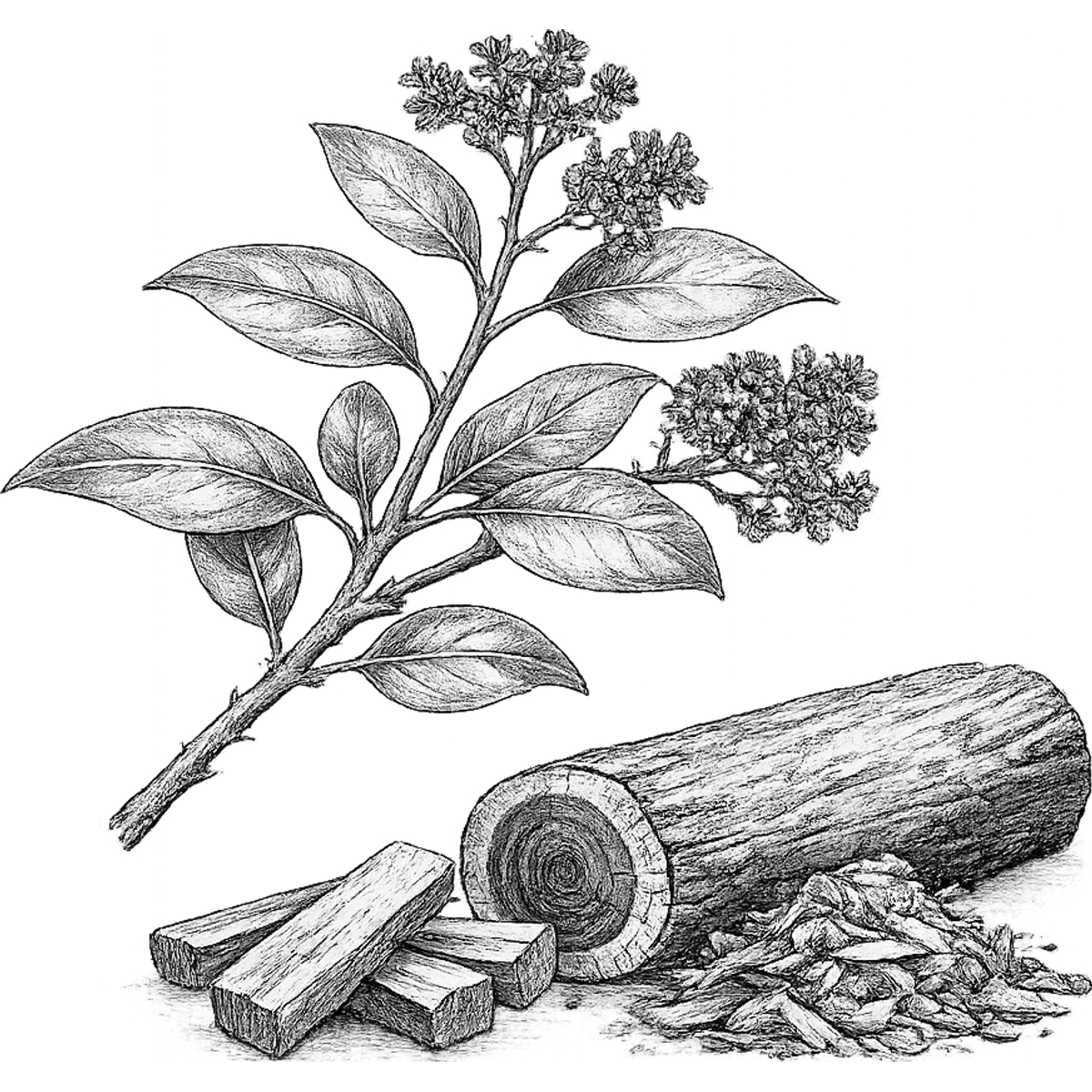
Australian Sandalwood oil from Santalum spicatum is chemically drier and woodier than its Indian counterpart, owing to a lower combined a- and β-santalol content (typically around 20-22%) and characteristically high levels of E,E-farnesol — a sesquiterpene alcohol that gives the oil a more diffuse, green-woody facet absent in S. album.[1] Geographic variation within Western Australian populations is substantial: northern and southwestern trees yield the highest santalol concentrations, a finding with direct relevance to sustainable plantation breeding.[2] In a controlled human psychophysiology study, inhalation of Western Australian sandalwood oil produced a statistically distinct reduction in salivary cortisol levels during a recovery phase, suggesting a measurable stress-modulating effect.[3]
- Also Known As
- Western Australian Sandalwood
- Family
- Woody
- Perfumery Note
- Base
- Intensity
- Medium
- Extraction
- Steam Distillation
- Plant Parts
- Wood
- Origins
- Australia
- Effect
- Calming & Relaxing, Grounding & Centering
- Aroma
- Woody, Dry, Earthy
- Applications
- Aromatherapy, Perfumery, Skincare, Massage
- Price
- $$$$Santalum spicatum from Western Australia is grown on certified sustainable plantations with a faster rotation than S. album; greater supply and lower regulatory burden place it well below East Indian sandalwood in price
References
- [1]A Comparison of the Composition of Selected Commercial Sandalwood Oils with the International Standard — Kucharska M, Frydrych B, Wesolowski W, Szymanska JA, Kilanowicz A. Molecules, 2021
- [2]Sesquiterpene Variation in West Australian Sandalwood (Santalum spicatum) — Moniodis J et al. Molecules, 2017
- [3]A Pilot Study on the Physiological Effects of Three Essential Oils in Humans — Höferl M, Hütter C, Buchbauer G. Natural Products Communications, 2016