 Essential Nose
Basil
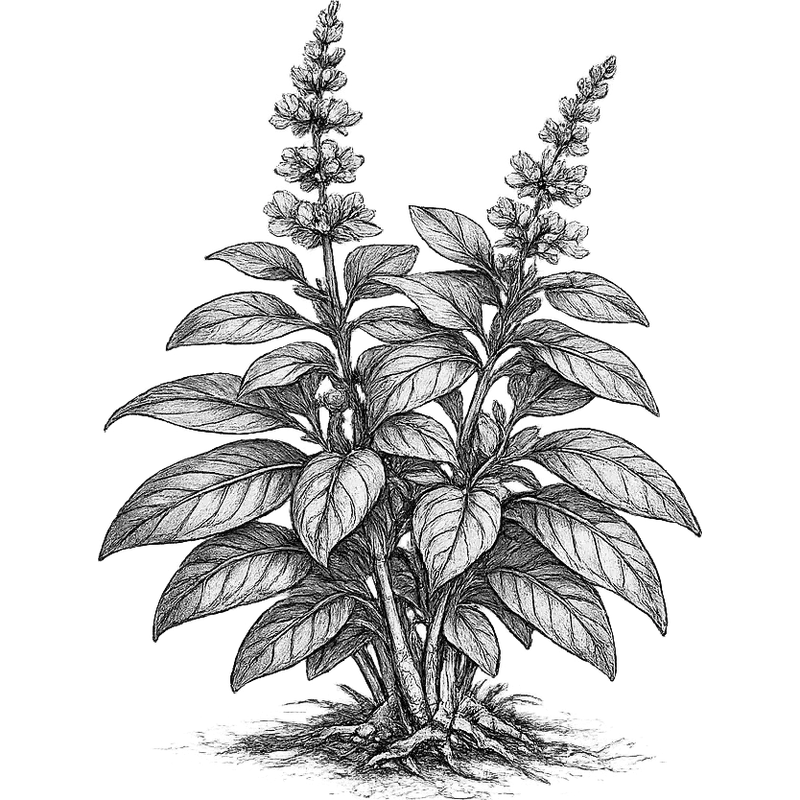
Basil oil comes in two quite different forms, depending on where the plant was grown. European basil runs on linalool, soft and sweet, and makes up around three fifths of the oil. Tropical basil runs on estragole instead, sharper and more aniseed-like. The linalool form held back Salmonella and Gram-positive bacteria, both in the dish and in food.[1] In mice, basil oil and estragole together brought down swelling and the markers that go with it.[2]
Holy Basil
Ocimum tenuiflorum
- Also Known As
- Tulsi, Sacred Basil, Holy Basil
- Family
- Herbal
- Perfumery Note
- Middle
- Intensity
- Medium
- Extraction
- Steam Distillation
- Plant Parts
- Leaves, Flowering tops
- Origins
- India, Southeast Asia
- Effect
- Focus & Mental Clarity
- Aroma
- Herbal, Spicy, Clove-like, Sweet
- Applications
- Diffusing & Inhalation
- Price
- $$$$Ocimum tenuiflorum (Tulsi) is cultivated mainly in India for religious and Ayurvedic markets; moderate production scale but niche demand in the aromatherapy world keeps pricing in the moderate range
Holy basil, or tulsi, is the sacred one, grown in courtyards across India and used daily in Ayurveda. It smells of cloves rather than basil, because eugenol leads instead of linalool. That is the same compound that makes clove oil numbing. The oil killed mosquito larvae at low concentrations and strongly slowed acetylcholinesterase, an enzyme insects depend on.[3] Its practical use is as a natural pesticide as much as an aromatic.
Lemon Basil
Ocimum x citriodorum
- Also Known As
- Citriodorum Basil, Thai Lemon Basil
- Family
- Herbal
- Perfumery Note
- Top
- Intensity
- Medium
- Extraction
- Steam Distillation
- Plant Parts
- Leaves, Flowering tops
- Origins
- Thailand, Africa, India
- Effect
- Energy & Uplifting, Focus & Mental Clarity
- Aroma
- Citrus, Herbal, Fresh, Lemon
- Applications
- Diffusing & Inhalation, Cooking & Flavouring
- Price
- $$$$Steam distillation of Ocimum citriodorum yields only ~0.07% oil - roughly 1,400 kg of plant per kg of oil - making it significantly lower-yielding than common sweet basil
Lemon basil is a cross between sweet basil and another Ocimum, bred for the citrus. Citral does most of that, with linalool and nerol softening it into something more floral than lemongrass. It works where you want basil's herbal edge without the aniseed. The published research used extracts of the plant rather than the distilled oil, and found they protected cells and held back bacteria.[4] Those are claims about the extract, not about what is in an oil bottle.
Sweet Basil
Ocimum basilicum
- Also Known As
- Common Basil, Garden Basil, European Basil
- Family
- Herbal
- Perfumery Note
- Top
- Intensity
- Medium
- Extraction
- Steam Distillation
- Plant Parts
- Leaves, Flowering tops
- Origins
- India, France, United States, Egypt
- Effect
- Focus & Mental Clarity
- Aroma
- Herbal, Sweet, Anisic, Fresh
- Applications
- Diffusing & Inhalation, Cooking & Flavouring
- Price
- $$$$Ocimum basilicum is widely cultivated across Europe and Asia for both culinary and aromatic use; the broad agricultural base and good oil yield from flowering tops keep it modestly priced
Sweet basil is the culinary one, and the oil smells like the leaf with the green turned up. Linalool gives the sweetness, estragole the aniseed edge, and the balance shifts with the season and the variety.[5] That means two bottles of sweet basil oil can smell noticeably different.[5] In lab tests it held back Staphylococcus aureus, E. coli and several fungi, and mopped up the unstable molecules that damage cells.[5] Separated fractions of the oil also damped down the signals the body uses to drive inflammation.[6]
References
- [1]Antimicrobial activity of basil (Ocimum basilicum) oil against Salmonella enteritidis in vitro and in food - Burt SA et al. Food Microbiol, 2010
- [2]Anti-inflammatory and antiedematogenic activity of the Ocimum basilicum essential oil and its main compound estragole: in vivo mouse models - Rodrigues MV et al. Inflammopharmacology, 2016
- [3]Essential Oil and Waste Hydrosol of Ocimum Tenuiflorum L.: A Low-Cost Raw Material Source of Eugenol, Botanical Pesticides, and Therapeutic Potentiality - Le DG et al. Chemical Biodiversity, 2024
- [4]Phytochemical Characterization and Bioactive Properties of Cinnamon Basil (Ocimum basilicum cv. 'Cinnamon') and Lemon Basil (Ocimum x citriodorum) - Majdi C et al. Antioxidants (Basel), 2020
- [5]Chemical composition, antioxidant and antimicrobial activities of basil (Ocimum basilicum) essential oils depends on seasonal variations - Hussain AI et al. Food Chemistry, 2008
- [6]Evaluation of the chemical composition, antioxidant and anti-inflammatory activities of distillate and residue fractions of sweet basil essential oil - Li H et al. Journal of Food Science and Technology, 2017