 Essential Nose
 East Indian Sandalwood
Santalum album
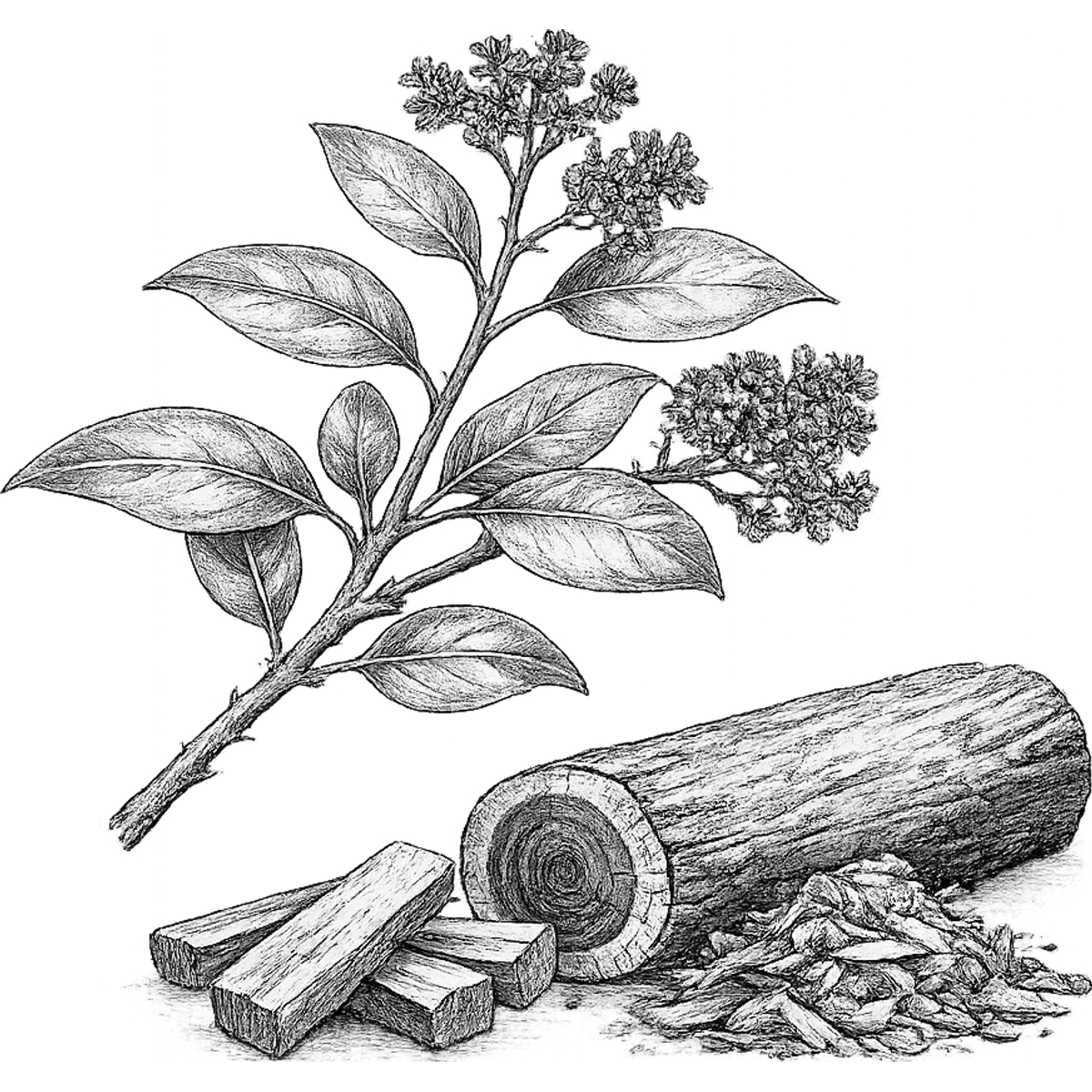
East Indian Sandalwood oil from Santalum album is defined by exceptionally high concentrations of (Z)-a-santalol (45-55%) and (Z)-β-santalol (20-25%) — the sesquiterpenoid alcohols responsible for its benchmark creamy, sweet, and long-lasting woody character.[1] A human transdermal absorption study found that a-santalol alone produced measurable physiological changes consistent with a relaxing and sedative effect, while the whole oil simultaneously provoked behavioural activation — a nuanced pharmacodynamic profile supporting its use in both calming and alerting aromatherapy contexts.[2] Clinical trials have further demonstrated that Santalum album oil is safe and well-tolerated in topical applications for acne, atopic dermatitis, psoriasis, and Molluscum contagiosum, with anti-inflammatory effects mediated partly through COX-1, COX-2, and 12-lipoxygenase inhibition.[3]
- Also Known As
- Sandalwood, White Sandalwood, Mysore Sandalwood
- Family
- Woody
- Perfumery Note
- Base
- Intensity
- Medium
- Extraction
- Steam Distillation
- Plant Parts
- Wood
- Origins
- India, Australia, Hawaii
- Effect
- Calming & Relaxing, Grounding & Centering
- Aroma
- Woody, Creamy, Light
- Applications
- Aromatherapy, Perfumery, Skincare, Massage
- Price
- $$$$Santalum album trees take 30-60 years to mature and are CITES-listed; tightly controlled Indian government exports and exceptionally high global demand from perfumery and ritual use make it the most expensive sandalwood
References
- [1]A Comparison of the Composition of Selected Commercial Sandalwood Oils with the International Standard — Kucharska M, Frydrych B, Wesolowski W, Szymanska JA, Kilanowicz A. Molecules, 2021
- [2]Evaluation of the effects of East Indian sandalwood oil and alpha-santalol on humans after transdermal absorption — Hongratanaworakit T, Heuberger E, Buchbauer G. Planta Medica, 2004
- [3]Sandalwood Album Oil as a Botanical Therapeutic in Dermatology — Moy RL, Levenson C. Journal of Clinical and Aesthetic Dermatology, 2017