 Essential Nose
Eucalyptus
Genus Eucalyptus
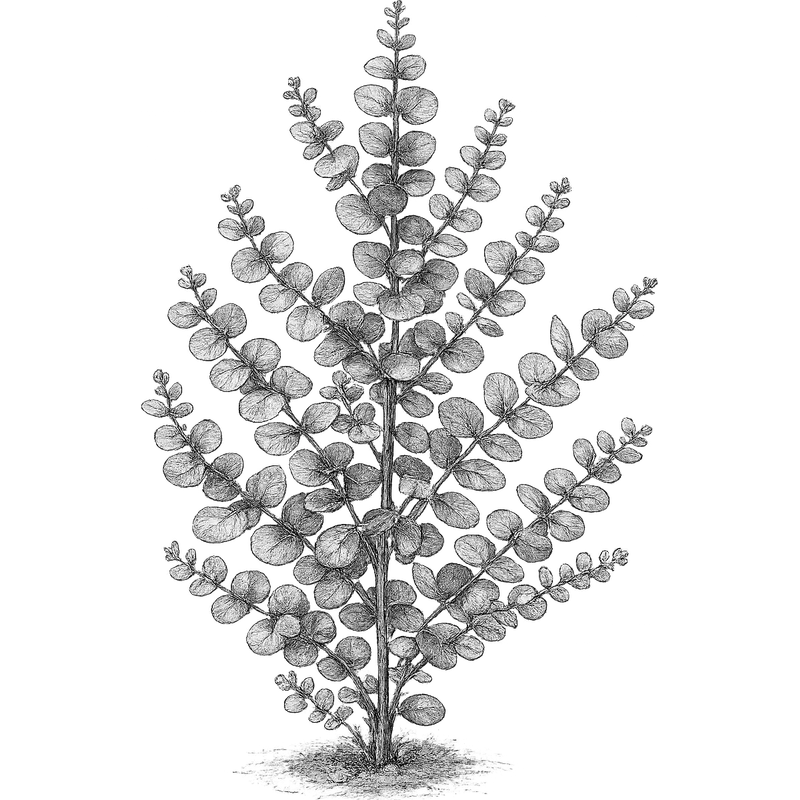
There are hundreds of eucalyptus species, and most of their oils are built on one compound: 1,8-cineole, also called eucalyptol. It is what makes a chest rub smell like a chest rub, and it loosens mucus, calms swelling and opens the airways.[1] Species differ more than you would expect. Blue gum is up to 85% cineole, radiata is softer, and lemon eucalyptus has almost none, running on citronellal instead.[2] The genus has been inhaled for chest complaints for a long time, and research backs its effect on bacteria, including MRSA.[2]
Blue Gum Eucalyptus
Eucalyptus globulus
- Also Known As
- Blue Gum, Tasmanian Blue Gum, Common Eucalyptus
- Family
- Herbal
- Perfumery Note
- Top
- Intensity
- Strong
- Extraction
- Steam Distillation
- Plant Parts
- Leaves
- Origins
- Australia, China, India
- Effect
- Focus & Mental Clarity, Respiratory Support
- Aroma
- Fresh, Camphorous, Sharp
- Applications
- Diffusing & Inhalation, Household & Cleaning
- Price
- $$$$The most mass-produced eucalyptus globally, cultivated at industrial scale in Australia, Spain, and China; exceptionally high oil yield keeps it among the cheapest essential oils
Blue gum is the eucalyptus you have almost certainly smelled, the one grown commercially more than any other. Up to 85% of its oil is cineole, which is why it hits the back of your nose so hard.[1] That makes it the strongest of the family for loosening a blocked chest. A 2023 review of 20 studies confirmed it works against MRSA, the bacterium that resists common antibiotics.[3] The same strength makes it harsh undiluted, and eucalyptus is named among the oils that can trigger seizures if swallowed.[4]
Eucalyptus Radiata
Eucalyptus radiata
- Also Known As
- Narrow-leaved Peppermint, Black Peppermint, Forth River Peppermint
- Family
- Herbal
- Perfumery Note
- Top
- Intensity
- Medium
- Extraction
- Steam Distillation
- Plant Parts
- Leaves
- Origins
- Australia
- Effect
- Respiratory Support, Energy & Uplifting
- Aroma
- Fresh, Clean, Slightly Fruity, Mild Camphor
- Applications
- Diffusing & Inhalation, Massage & Body
- Price
- $$$$Grown at commercial scale in Australia though in smaller volumes than Blue Gum; good yield and straightforward distillation keep it affordable, with a slight premium for its gentler profile
Radiata is the gentle eucalyptus, the one to use when blue gum is too much. It still runs on cineole, but less of it, and more alpha-terpineol and limonene, which round the sharpness into something fresher and slightly fruity. Aromatherapists reach for it with children and sensitive skin.[5] In a comparison of eight eucalyptus species, radiata held back bacteria and protected cells from damage in lab tests.[5] It behaved differently from blue gum, so the two differ by more than cineole content.
Lemon Eucalyptus
Eucalyptus citriodora
- Also Known As
- Citron-scented Gum, Lemon-scented Gum, Spotted Gum
- Family
- Herbal
- Perfumery Note
- Top
- Intensity
- Strong
- Extraction
- Steam Distillation
- Plant Parts
- Leaves
- Origins
- Australia, Brazil, China, South Africa
- Effect
- Energy & Uplifting, Respiratory Support
- Aroma
- Citrusy, Fresh, Lemony, Clean
- Applications
- Diffusing & Inhalation, Household & Cleaning
- Price
- $$$$Corymbia citriodora is cultivated mainly in Australia and Brazil; moderate yield but a more specialised market means smaller production runs and a modest price premium over standard eucalyptus
Lemon eucalyptus barely belongs in the family by smell. It has almost no cineole, running instead on citronellal, which makes it sharply lemony rather than medicinal. Its real use is keeping insects off you. Citronellal is the raw material for PMD, the repellent made from this oil, and an effective plant-based alternative to DEET with less toxicity.[6] In a field test it kept 85% of ticks away on the first day.[7]
Eucalyptus Dives
Eucalyptus dives
- Also Known As
- Broad-leaved Peppermint, Blue Peppermint, Peppermint Eucalyptus
- Family
- Herbal
- Perfumery Note
- Top
- Intensity
- Strong
- Extraction
- Steam Distillation
- Plant Parts
- Leaves
- Origins
- Australia
- Effect
- Respiratory Support
- Aroma
- Peppermint-like, Camphoraceous, Fresh, Herbaceous
- Applications
- Diffusing & Inhalation, Household & Cleaning
- Price
- $$$$A broad-leaved species distilled mostly in Australia and South Africa; lower commercial demand than Blue Gum means smaller batch sizes and a slightly higher price per unit
Despite the name, this one smells of peppermint rather than eucalyptus. It skips cineole almost entirely and runs on piperitone, which is what shifts the smell towards mint and camphor. That makes it the odd one out in a genus built on a single compound. Piperitone taken from the oil killed pantry moths and flour beetles, both by contact and as a vapour.[8] It is the pest control end of the eucalyptus family rather than the chest rub end.
Eucalyptus Polybractea
Eucalyptus polybractea
- Also Known As
- Blue Mallee, Cineole Eucalyptus
- Family
- Herbal
- Perfumery Note
- Top
- Intensity
- Strong
- Extraction
- Steam Distillation
- Plant Parts
- Leaves
- Origins
- Australia
- Effect
- Respiratory Support
- Aroma
- Eucalyptus, Sharp, Fresh, Medicinal
- Applications
- Diffusing & Inhalation, Household & Cleaning
- Price
- $$$$"Blue Mallee" eucalyptus; specifically farmed for the highest possible cineole yield
Blue Mallee packs more cineole than almost any eucalyptus, around 83% of the oil. That makes it the sharpest and most medicinal of the group, and the most useful when you want a blocked head cleared fast. It is not a subtle oil, and a little goes a long way. In lab tests of several Western Australian species, Blue Mallee and blue gum held back bacteria best.[9] Those included Acinetobacter baumannii, a hospital bug that shrugs off most antibiotics.[9]
Eucalyptus Smithii
Eucalyptus smithii
- Also Known As
- Gully Gum, Blackbutt Peppermint
- Family
- Herbal
- Perfumery Note
- Top
- Intensity
- Medium
- Extraction
- Steam Distillation
- Plant Parts
- Leaves
- Origins
- Australia
- Effect
- Respiratory Support
- Aroma
- Eucalyptus, Fresh, Medicinal, Mild
- Applications
- Diffusing & Inhalation, Massage & Body
- Price
- $$$$Gully gum is cultivated mainly in South Africa for the therapeutic market; limited global production volume means it costs a little more than widely traded eucalyptus species
Gully Gum smells like eucalyptus with the edges taken off. Around 72% of its oil is cineole, the compound behind that clean, medicinal hit, where Blue Mallee holds 83%. That is still plenty to clear a blocked head, but gentle enough for everyday use and for children. In lab tests it held back all six of the fungi behind athlete's foot and ringworm, including Trichophyton rubrum.[10] Microscope images confirmed the fungal cells were physically damaged.[10]
Eucalyptus Staigeriana
Eucalyptus staigeriana
- Also Known As
- Lemon-scented Ironbark, Stagger Leaf Gum
- Family
- Herbal
- Perfumery Note
- Top
- Intensity
- Medium
- Extraction
- Steam Distillation
- Plant Parts
- Leaves
- Origins
- Australia
- Effect
- Energy & Uplifting, Respiratory Support
- Aroma
- Lemon, Citrus, Fresh, Herbal
- Applications
- Diffusing & Inhalation, Massage & Body, Perfumery & Fragrance Making
- Price
- $$$$A specialty lemon-ironbark species with very limited commercial cultivation; small-batch production from select Australian farms makes it noticeably more expensive than mainstream eucalyptus oils
Lemon-scented Ironbark is the sweetest eucalyptus, lemony and almost herbal. It carries citral and limonene alongside the usual cineole, and the citrus notes win. That makes it the one to use when you want the freshness without the medicine cabinet. Its odd claim to fame is worming livestock. In lab tests it stopped 99% of parasite eggs hatching, and in goats it cleared about three quarters of gut worms within a fortnight.[11]
References
- [1]1,8-cineole (eucalyptol): A versatile phytochemical with therapeutic applications across multiple diseases - Hoch CC et al. Biomedicine & Pharmacotherapy, 2023
- [2]Immune-modifying and antimicrobial effects of Eucalyptus oil and simple inhalation devices - Sadlon AE, Lamson DW. Alternative Medicine Review, 2010
- [3]Antibacterial Properties of Eucalyptus globulus Essential Oil against MRSA: A Systematic Review - Elangovan S, Mudgil P. Antibiotics (Basel), 2023
- [4]The Effects of Various Essential Oils on Epilepsy and Acute Seizure: A Systematic Review - Bahr TA et al. Evidence-Based Complementary and Alternative Medicine, 2019
- [5]Antibacterial, Antioxidant, and Antiproliferative Activities of Corymbia citriodora and the Essential Oils of Eight Eucalyptus Species - Miguel MG et al. Medicines (Basel), 2018
- [6]Comparison of the cytotoxicity and zebrafish embryo toxicity of insect repellent ingredients: p-Menthane-3,8-diol synthesized by green chemistry from Eucalyptus citriodora and N,N-diethyl-meta-toluamide - Ozokan G et al. Drug and Chemical Toxicology, 2024
- [7]Repellency of oils of lemon eucalyptus, geranium, and lavender and the mosquito repellent MyggA natural to Ixodes ricinus (Acari: Ixodidae) in the laboratory and field - Jaenson TGT et al. Journal of Medical Entomology, 2006
- [8]Toxicities of Eucalyptus dives Oil, 3-Carvomenthenone, and Its Analogues against Stored-Product Insects - Park JH, Lee HS. Journal of Food Protection, 2018
- [9]Antimicrobial Activity of Several Cineole-Rich Western Australian Eucalyptus Essential Oils - Aldoghaim FS, Flematti GR, Hammer KA. Microorganisms, 2018
- [10]Chemical composition and antifungal activity of essential oil from Eucalyptus smithii against dermatophytes - Baptista EB, Zimmermann-Franco DC, Lataliza AAB, Raposo NRB. Revista da Sociedade Brasileira de Medicina Tropical, 2015
- [11]Anthelmintic effect of Eucalyptus staigeriana essential oil against goat gastrointestinal nematodes - Macedo ITF, Bevilaqua CML, de Oliveira LMB et al. Veterinary Parasitology, 2010