 Essential Nose
Galangal
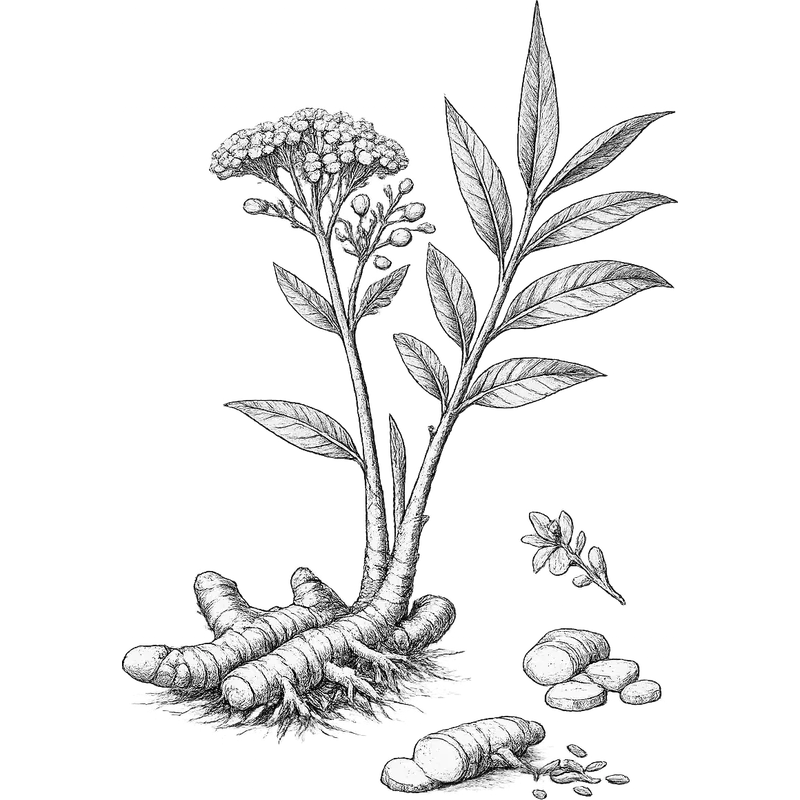
Galangal is a ginger relative, but the oil smells nothing like ginger. Cineole and pine notes dominate instead of the warm spice, making it sharp, camphorous and peppery. Greater galangal is the Thai cooking rhizome, while lesser galangal is smaller, hotter and older in the herbal record. Distilling fresh rather than dried rhizome gives more of the volatile compounds and better cell protection.[1] The oil also killed stored-grain beetles as effectively as synthetic fumigants in testing.[1]
Greater Galangal
Alpinia galanga
- Also Known As
- Galangal, Thai Ginger, Blue Ginger, Laos Root
- Family
- Spice
- Perfumery Note
- Middle
- Intensity
- Medium
- Extraction
- Steam Distillation
- Plant Parts
- Roots
- Origins
- Thailand, Indonesia, Malaysia, Vietnam, India
- Effect
- Respiratory Support, Energy & Uplifting
- Aroma
- Spicy, Peppery, Camphoraceous, Earthy, Warm
- Applications
- Diffusing & Inhalation, Massage & Body, Cooking & Flavouring
- Price
- $$$$Galangal rhizomes are widely cultivated across Southeast Asia as an agricultural commodity; oil yield is moderate and the oil is commercially available at accessible pricing
This is the galangal of Thai curry paste, a knobbly rhizome that looks like ginger and tastes nothing like it. The oil is built on 1,8-cineole and alpha-pinene, with methyl cinnamate adding a sweet, almost balsamic edge. The result is camphorous and peppery rather than warm. How it is dried matters: distilling fresh rhizome keeps more of the volatile compounds and gives better cell protection than drying first.[1] In fumigation tests it killed flour beetles at doses competitive with synthetic pesticides.[1]
Lesser Galangal
Alpinia officinarum
- Also Known As
- China Root, Colic Root, East India Catarrh Root
- Family
- Spice
- Perfumery Note
- Middle
- Intensity
- Strong
- Extraction
- Steam Distillation
- Plant Parts
- Rhizomes
- Origins
- China, Vietnam
- Effect
- Energy & Uplifting, Respiratory Support, Focus & Mental Clarity
- Aroma
- Camphoraceous, Spicy, Clove-like, Warm, Peppery
- Applications
- Diffusing & Inhalation, Cooking & Flavouring
- Price
- $$$$Rarer in commercial production than Greater Galangal, with smaller rhizomes and lower oil yield concentrated in a handful of Chinese growing regions.
Lesser galangal is the smaller, hotter cousin, known in old herbals as China root and colic root. Its oil is led by 1,8-cineole with farnesene and terpineol, giving a sharper, more clove-like heat.[2] Galangin, the compound Chinese pharmacopoeia uses to check quality, sits in the non-volatile part, not the oil.[3] In lab tests the oil held back Gram-positive bacteria and damped inflammatory signalling.[3] One form of it nearly wiped out Pseudomonas aeruginosa, beating a standard antibiotic,[4] and it also stopped a crop fungus.[5]
References
- [1]Assessment of fresh Alpinia galanga (A. galanga) drying techniques for the chemical composition of essential oil and its antioxidant and biological activity -- Ge X et al. Food Chemistry, 2022
- [2]GC and GC/MS analysis of the volatile constituents of the oils of Alpinia galanga (L.) Willd and A. officinarum Hance rhizomes - Rana VS, Verdeguer M, Blazquez MA. Journal of Essential Oil Research, 2010
- [3]Chemical profiling and bioactivity of essential oils from Alpinia officinarum Hance from ten localities in China - Zhang L, Pan C, Ou Z, et al. Industrial Crops and Products, 2020
- [4]Alpinia officinarum Hance essential oil as potent antipseudomonal agent: chemical profile, antibacterial activity, and computational study - Belamine H, El Ghallab Y, Zahid B, et al. Chemistry and Biodiversity, 2025
- [5]Integrated physiological, metabolomic, and proteome analysis of Alpinia officinarum Hance essential oil inhibits the growth of Fusarium oxysporum of Panax notoginseng - Liu XY, Huo YY, Yang J, et al. Frontiers in Microbiology, 2022