 Essential Nose
Geranium
Genus Pelargonium
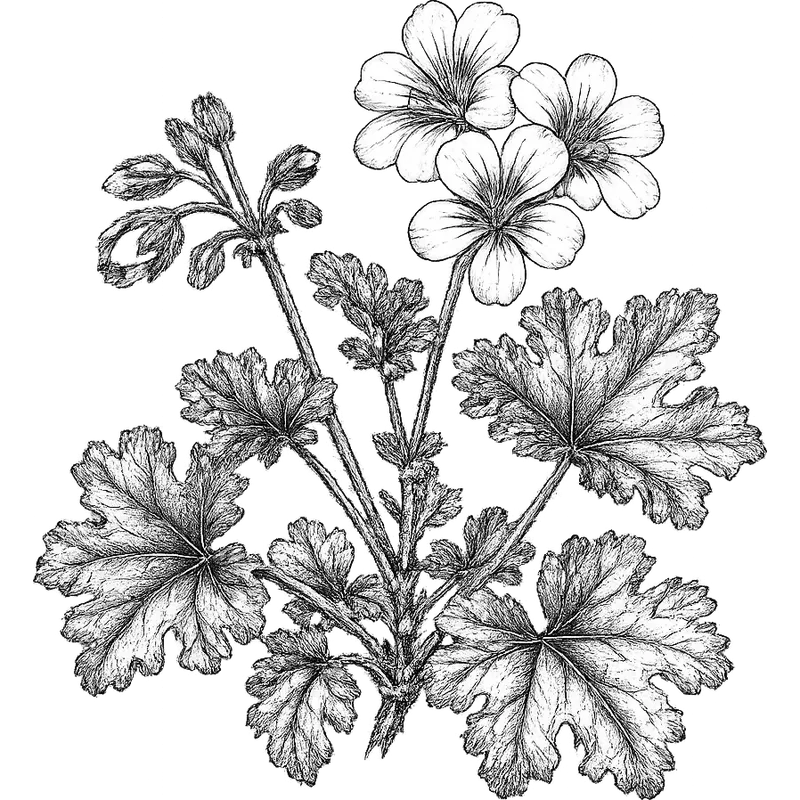
Geranium smells like rose crossed with something green and minty, and it is the standard affordable stand-in for rose. Two compounds do it: citronellol at roughly a third of the oil and geraniol at half that.[3] Push the geraniol up and you get rose geranium, closer to the real thing. In a study of patients in moderate to severe pain, inhaling geranium oil lowered their anxiety scores.[4] The same two compounds are behind most of its action against bacteria.[3]
Geranium
Pelargonium graveolens
- Also Known As
- Rose Geranium
- Family
- Floral
- Perfumery Note
- Middle
- Intensity
- Medium
- Extraction
- Steam Distillation
- Plant Parts
- Leaves
- Origins
- Egypt, China, Madagascar
- Effect
- Grounding & Centering, Sleep & Relaxation
- Aroma
- Floral, Sweet, Rosy
- Applications
- Diffusing & Inhalation, Skincare, Massage & Body, Perfumery & Fragrance Making
- Price
- $$$$A specific cultivar bred to smell more like roses; moderate yield
This is the standard geranium, grown mostly in Egypt, Reunion Island and China. Citronellol and geraniol give it the rose, and a minty green edge underneath keeps it from being a straight copy. In lab tests it stopped every clinical sample of Staphylococcus aureus it was tried against, including MRSA and strains resistant to several drugs.[3] Those same two compounds are what do it.[3] It also scores well at mopping up the unstable molecules that damage cells.[4]
Rose Geranium
Pelargonium graveolens var. roseum
- Also Known As
- Bourbon Geranium, Rose-Scented Geranium
- Family
- Floral
- Perfumery Note
- Middle
- Intensity
- Medium
- Extraction
- Steam Distillation
- Plant Parts
- Leaves
- Origins
- Reunion Island, Madagascar, South Africa
- Effect
- Grounding & Centering, Energy & Uplifting
- Aroma
- Floral, Rosy, Sweet
- Applications
- Diffusing & Inhalation, Skincare, Massage & Body, Perfumery & Fragrance Making
- Price
- $$$$Pelargonium graveolens var. roseum is cultivated mainly in South Africa and Egypt; large plantation scale and reliable steam-distillation yields keep it among the more affordable floral oils
Rose geranium is the variety bred to smell most like an actual rose. Citronellol still leads at around two fifths of the oil, but extra geraniol and fruity esters round off the green edge.[5] That is why it is the version used in skincare and in affordable rose blends. In dish tests it held back bacteria of both main types and stopped Candida growing completely.[5] It also mops up the unstable molecules that damage cells better than plain geranium.[4]
Bourbon Geranium
Pelargonium x asperum
- Also Known As
- Geranium Bourbon, Reunion Geranium
- Family
- Floral
- Perfumery Note
- Middle
- Intensity
- Medium
- Extraction
- Steam Distillation
- Plant Parts
- Leaves
- Origins
- Reunion Island, Madagascar
- Effect
- Grounding & Centering, Sleep & Relaxation
- Aroma
- Floral, Rosy, Green, Sweet
- Applications
- Diffusing & Inhalation, Skincare, Massage & Body, Perfumery & Fragrance Making
- Price
- $$$$Grown on Reunion Island (historically known as Ile Bourbon); the island's limited agricultural land restricts total production volume, and the Bourbon provenance commands a premium over other geranium origins
Bourbon geranium comes from Reunion Island, once called Ile Bourbon, and perfumers treat it as the finest grade. It carries more citronellol relative to geraniol than other origins, which is what gives it that clean rose quality.[1] Isomenthone adds a minty lift that rises and falls with the altitude and the temperature of the growing season.[1] A handful of heavier compounds found only in this origin act as its fingerprint.[1] There is no trial evidence specific to Bourbon, only to geranium oil in general.
Egyptian Geranium
Pelargonium graveolens
- Also Known As
- Rose Geranium (Egypt), Geranium Egypt
- Family
- Floral
- Perfumery Note
- Middle
- Intensity
- Medium
- Extraction
- Steam Distillation
- Plant Parts
- Leaves
- Origins
- Egypt
- Effect
- Grounding & Centering, Energy & Uplifting
- Aroma
- Floral, Rosy, Sweet, Herbaceous
- Applications
- Diffusing & Inhalation, Skincare, Massage & Body, Perfumery & Fragrance Making
- Price
- $$$$Egypt is the world's largest producer of geranium oil; the high cultivation volume and competitive local labour costs make Egyptian geranium the most affordable of the named geranium origins
Egypt is one of the biggest geranium producers in the world, exporting over 250 tonnes of oil a year. Its oil runs about a quarter citronellol, with citronellyl formate adding a fruity softness the other origins have less of.[1] The exact balance shifts with the weather, the altitude and how far into flowering the plants were when cut.[1] In lab tests it broke up the protective films that drug-resistant bacteria build on surfaces.[6] That is a dish finding, but a useful one for cleaning products.
References
- [1]An In-Depth Study on the Chemical Composition and Biological Effects of Pelargonium graveolens Essential Oil - Kacaniova M, Vukic M, Vukovic NL, et al. Foods, 2023
- [2]Inhalation of Pelargonium graveolens Essential Oil Alleviates Pain and Related Anxiety and Stress in Patients with Lumbar Spinal Stenosis and Moderate to Severe Pain - Seo E, Cho Y, Lee JM, Seol GH. Pharmaceuticals (Basel), 2023
- [3]Antimicrobial Activity of Geranium Oil against Clinical Strains of Staphylococcus aureus - Bigos M et al. Molecules, 2012
- [4]Chemical composition and biological activities of polar extracts and essential oil of rose-scented geranium, Pelargonium graveolens - Boukhris M et al. Phytotherapy Research, 2013
- [5]Antimicrobial and Antifungal Activity of Pelargonium roseum Essential Oils - Galea C and Hancu G. Advances in Pharmaceutical Bulletin, 2014
- [6]Antimicrobial synergism and antibiofilm activities of Pelargonium graveolens, Rosemary officinalis, and Mentha piperita essential oils against extreme drug-resistant Acinetobacter baumannii clinical isolates - Qasim M et al. PLoS ONE, 2021