 Essential Nose
Ginger
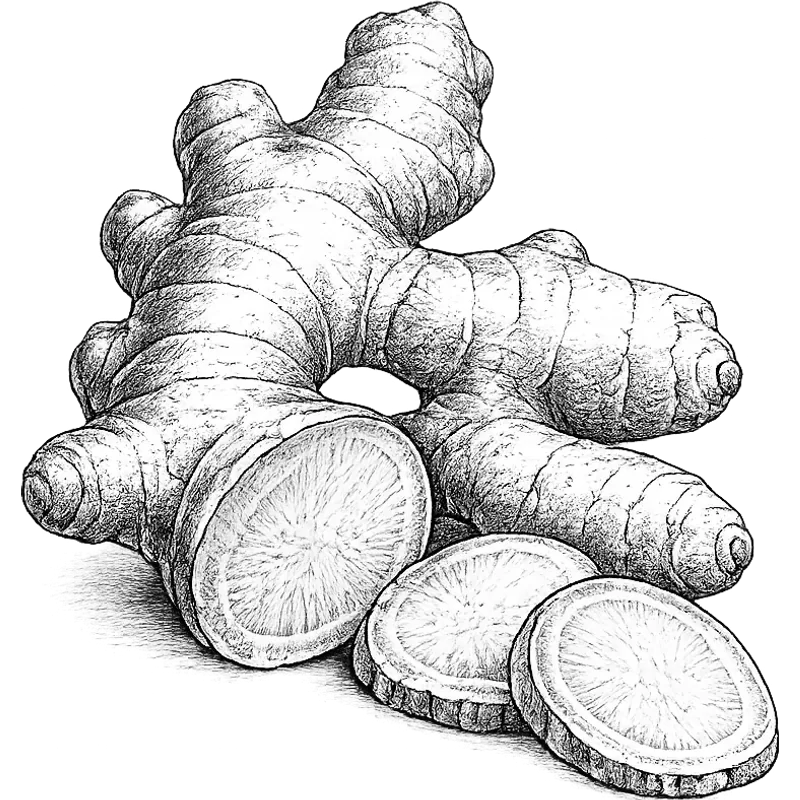
Ginger oil is distilled from the root, and it does not taste of ginger. The heat and bite of fresh ginger come from gingerols, which are too heavy to travel with the steam and stay behind in the root. What comes over is zingiberene and its relatives, giving a warm, woody spice without the burn. In a study of patients after abdominal surgery, smelling the oil reduced sickness and vomiting in the first six hours.[2] The plant has been used as a medicine for five thousand years across Ayurvedic, Chinese and Unani traditions.
Ginger
Zingiber officinale
- Also Known As
- Ginger Root
- Family
- Spice
- Perfumery Note
- Middle
- Intensity
- Strong
- Extraction
- Steam Distillation
- Plant Parts
- Rhizome (Root)
- Origins
- India, China, Indonesia
- Effect
- Energy & Uplifting, Warming & Comforting
- Aroma
- Spicy, Warm, Woody
- Applications
- Diffusing & Inhalation, Massage & Body, Cooking & Flavouring
- Price
- $$$$The dried roots are dense; steam distillation is slow to extract the heavy aromatic molecules
This is the steam-distilled oil, warm and woody rather than hot. Around a third of it is zingiberene, with a supporting cast of related compounds that give the spice its depth. The gingerols that make fresh ginger burn are not in it, because they do not survive distillation. In a trial of 60 women having chemotherapy, inhaling the oil lowered nausea on the first day.[2] The benefit did not hold across the whole course, vomiting did not improve, and the researchers called the case unconvincing.[2]
Ginger CO2
Zingiber officinale
- Also Known As
- CO2 Ginger Extract, Supercritical Ginger, Ginger Oleoresin
- Family
- Spice
- Perfumery Note
- Middle
- Intensity
- Strong
- Extraction
- CO2 Extraction
- Plant Parts
- Rhizome
- Origins
- India, Madagascar, China
- Effect
- Energy & Uplifting
- Aroma
- Warm, Spicy, Rich, Root-like, Earthy
- Applications
- Diffusing & Inhalation, Perfumery & Fragrance Making, Cooking & Flavouring
- Price
- $$$$Supercritical CO2 extraction requires specialised high-pressure equipment and higher input costs than steam distillation; significantly more expensive per unit volume
This is an extract, made by squeezing carbon dioxide into a liquid and washing the compounds out of the root. Because it runs cool, it keeps the gingerols that steam distillation destroys.[3] That is why it smells like actually cutting into fresh ginger, resinous and heavy, where the distilled oil smells lighter and drier. 6-gingerol is the compound behind ginger's reputation for settling the stomach and calming swelling. If that is what you want from ginger, this is the form that carries it.[4]
Plai
Zingiber zerumbet
- Also Known As
- Cassumunar Ginger, Bitter Ginger, Shampoo Ginger, Zerumbet Ginger
- Family
- Spice
- Perfumery Note
- Middle
- Intensity
- Strong
- Extraction
- Steam Distillation
- Plant Parts
- Rhizome
- Origins
- Thailand, Malaysia, Indonesia
- Effect
- Warming & Comforting, Respiratory Support
- Aroma
- Camphorous, Fresh, Spicy, Herbaceous, Medicinal
- Applications
- Diffusing & Inhalation, Massage & Body
- Price
- $$$$Specialist oil primarily produced in Southeast Asia; limited Western distribution infrastructure and small-batch production drive higher retail prices
Plai is a Thai relative of ginger, but it smells nothing like it, sharp and camphorous rather than warm. Its defining compound is zerumbone, which common ginger does not make at all. In mice, zerumbone damped down both short-term and long-term inflammation, and did so more the higher the dose.[5] Reviews find it eases pain and swelling by a different route from ginger's gingerols.[6] Thai massage has used it on strains and sprains for a long time, and sports therapists in the West have taken it up.
References
- [1]Effectiveness of Ginger Essential Oil on Postoperative Nausea and Vomiting in Abdominal Surgery Patients - Lee YR, Shin HS. Journal of Alternative and Complementary Medicine, 2017
- [2]Effects of inhaled ginger aromatherapy on chemotherapy-induced nausea and vomiting and health-related quality of life in women with breast cancer - Lua PL, Salihah N, Mazlan N. Complementary Therapies in Medicine, 2015
- [3]Impact of drying and extractions processes on the recovery of gingerols and shogaols, the main bioactive compounds of ginger - Brindzova L et al. Plants, 2022
- [4]Assay of 6-gingerol in CO2 supercritical fluid extracts of ginger and evaluation of its sustained release from a transdermal delivery system across rat skin - Wang C et al. International Journal of Pharmaceutics, 2014
- [5]Anti-inflammatory effect of zerumbone on acute and chronic inflammation models in mice - Sulaiman MR et al. Basic & Clinical Pharmacology & Toxicology, 2010
- [6]Zingiber zerumbet: A Scoping Review of its Medicinal Properties - Al-Snafi AE. Journal of Pharmaceutical Sciences, 2023