 Essential Nose
Juniper
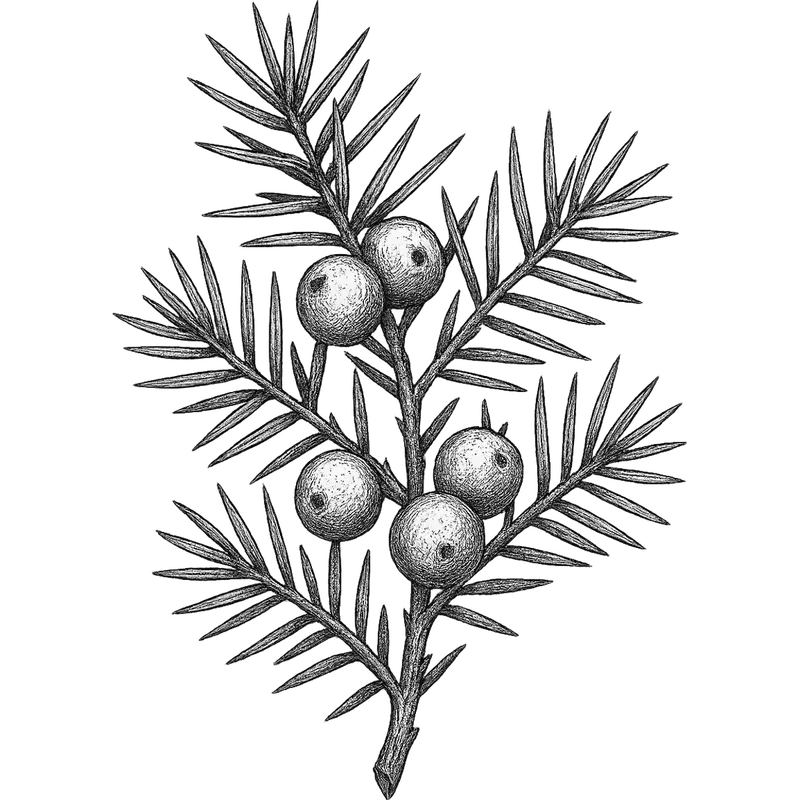
Juniper is the gin smell, sharp and green with a resinous pine edge. Berry oil is up to half alpha-pinene, and the group also covers needle oil and cade, which is juniper tar. Cade is a different animal entirely, smoky and medicinal rather than fresh. In lab tests on berry oil, only one of three samples held back bacteria and Candida strongly, which shows how much batches differ.[1] Alpha-pinene on its own is antibacterial, but no single compound beat the whole oil.[1][2]
Juniper Berry
Juniperus communis
- Also Known As
- Common Juniper
- Family
- Woody
- Perfumery Note
- Middle
- Intensity
- Medium
- Extraction
- Steam Distillation
- Plant Parts
- Ripe berries
- Origins
- Bulgaria, Hungary, France
- Effect
- Grounding & Centering, Respiratory Support
- Aroma
- Fresh, Woody, Pine-like
- Applications
- Diffusing & Inhalation, Skincare, Massage & Body
- Price
- $$$$The berries take 2-3 years to ripen on the bush; yield is moderate
These are the berries that flavour gin, though botanically they are cones rather than fruit. Alpha-pinene can be half the oil, with myrcene and sabinene filling out the resinous, green sharpness. In lab tests against bacteria and Candida taken from hospital patients, one of three oil samples worked well and the other two did not.[1] No single compound in it beat the whole oil, so whatever does the work is the combination.[1] Alpha-pinene by itself is antibacterial, which explains part but not all of it.[2]
Cade
Juniperus oxycedrus
- Also Known As
- Juniper Tar, Prickly Juniper
- Family
- Woody
- Perfumery Note
- Base
- Intensity
- Very Strong
- Extraction
- Destructive Distillation
- Plant Parts
- Wood
- Origins
- Spain, Morocco, France
- Effect
- Grounding & Centering, Respiratory Support
- Aroma
- Smoky, Woody, Tar-like
- Applications
- Diffusing & Inhalation, Skincare, Haircare, Perfumery & Fragrance Making
- Price
- $$$$Produced by destructive distillation (scorching) of the wood; an inexpensive industrial process
Cade is a tar, made by burning juniper wood slowly and catching what runs off. It smells of smoke, leather and creosote, and it is one of the few oils people recognise instantly without liking. Phenols like guaiacol and cresol give it that smell and its long use on scaly, itchy skin. Work on the oil found it fought bacteria and helped wounds close.[3] Those same phenols are why a cosmetic safety review flagged it as risky at high doses.[4]
Juniper Needle
Juniperus communis
- Also Known As
- Juniper Leaf, Juniper Twig
- Family
- Woody
- Perfumery Note
- Middle
- Intensity
- Medium
- Extraction
- Steam Distillation
- Plant Parts
- Needles, Branches
- Origins
- France, Italy, Switzerland
- Effect
- Respiratory Support, Grounding & Centering, Focus & Mental Clarity
- Aroma
- Fresh, Coniferous, Green
- Applications
- Diffusing & Inhalation, Massage & Body, Household & Cleaning
- Price
- $$$$Harvested from the same widespread shrub as juniper berries, but needle-specific distillation runs are less common commercially, keeping it a modest step up from berry oil
Needle oil comes from the foliage and young twigs rather than the berries. It is sharper and greener, closer to a cut conifer than to gin. Limonene leads instead of the berry's myrcene, which is what lifts it and makes it smell fresher. A survey of 109 samples from Corsica found two clearly different forms of the oil, one built on limonene and one on sabinene.[5] Which one you get depends on where the tree grew.[5]
References
- [1]Antibacterial and antifungal activity of juniper berry oil and its selected components - Filipowicz N, Kaminski M, Kurlenda J, Asztemborska M, Ochocka JR. Phytotherapy Research, 2003
- [2]Therapeutic potential of alpha- and beta-pinene: a miracle gift of nature - Salehi B, Upadhyay S, Erdogan Orhan I, et al. Biomolecules, 2019
- [3]Juniperus oxycedrus L. ssp. Essential Oil Microneedles: A Promising Antimicrobial and Wound Healing Activity - Limem I et al. Pharmaceuticals, 2024
- [4]Final report on the safety assessment of Juniperus communis Extract, Juniperus oxycedrus Extract, Juniperus oxycedrus Tar, Juniperus phoenicea extract, and Juniperus virginiana Extract - Cosmetic Ingredient Review. Int J Toxicol, 2001
- [5]Chemical variability of the needle oil of Juniperus communis ssp. alpina from Corsica - Ottavioli J, Gonny M, Casanova J, Bighelli A. Chemistry & Biodiversity, 2009