 Essential Nose
Marjoram
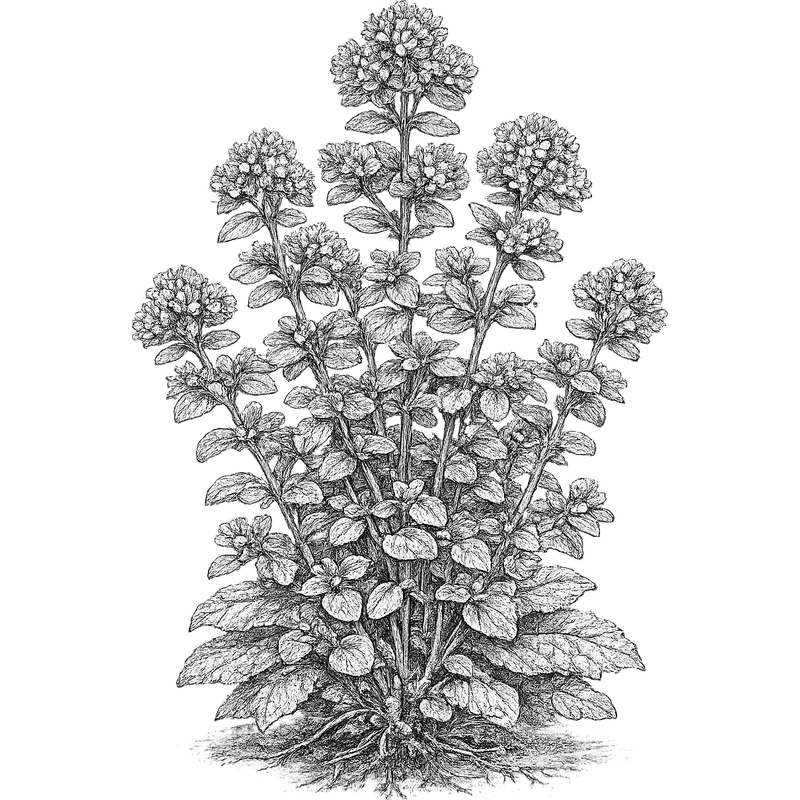
Two unrelated plants are sold as marjoram. Sweet marjoram is a true Origanum, warm and herbal, and the one most people mean. Spanish marjoram is actually a thyme, and smells camphorous rather than sweet. Sweet marjoram runs on terpinen-4-ol, the same compound that carries tea tree, which is behind its action on bacteria and biofilms.[1] In tests on rat and rabbit gut muscle, the oil relaxed contractions directly, which fits its old use for cramps.[2]
Marjoram
Origanum majorana
- Also Known As
- Sweet Marjoram, Knotted Marjoram
- Family
- Herbal
- Perfumery Note
- Middle
- Intensity
- Medium
- Extraction
- Steam Distillation
- Plant Parts
- Flowering tops
- Origins
- Egypt, France, Tunisia
- Effect
- Sleep & Relaxation, Grounding & Centering
- Aroma
- Herbal, Warm, Woody
- Applications
- Diffusing & Inhalation, Massage & Body, Cooking & Flavouring
- Price
- $$$$Not a true marjoram (closer to thyme/oregano); grows wild and yields oil easily
Sweet marjoram is the gentle end of the oregano family, warm and woody where oregano is fierce. Terpinen-4-ol leads, the same compound that does the work in tea tree, with sabinene and linalool behind it. That is why it smells herbal rather than medicinal, and why it is used for winding down rather than clearing out. In lab tests the oil held back bacteria and stopped them forming protective films.[1] On isolated rat and rabbit gut muscle it relaxed contractions directly, which is the old remedy for cramps and colic explained.[2]
Marjoram Spanish
Thymus mastichina
- Also Known As
- Spanish Marjoram, Spanish Wood Marjoram
- Family
- Herbal
- Perfumery Note
- Top
- Intensity
- Medium
- Extraction
- Steam Distillation
- Plant Parts
- Flowering tops, Leaves
- Origins
- Spain, Portugal, Morocco
- Effect
- Respiratory Support, Focus & Mental Clarity
- Aroma
- Camphoraceous, Herbal, Fresh
- Applications
- Diffusing & Inhalation, Massage & Body
- Price
- $$$$A specialty thyme-family oil grown mainly in Iberia; lower production volume than true marjoram keeps it mid-priced
Spanish marjoram is not marjoram at all, but a Spanish thyme. Where sweet marjoram runs on terpinen-4-ol, this one is more than half 1,8-cineole, the eucalyptus compound. So it smells sharp and camphorous, and belongs in a chest rub rather than a sleep blend. Oils from wild Portuguese thymes with the same cineole and linalool chemistry held back E. coli, Staphylococcus aureus and Candida.[3] The two marjorams are not interchangeable, despite the shared shelf name.
References
- [1]Origanum majorana Essential Oil - A Review of Its Chemical Profile and Pesticide Activity - Kakouri E et al. Life (Basel), 2022
- [2]Myorelaxant Activity of essential oil from Origanum majorana L. on rat and rabbit - Makrane H et al. Journal of Ethnopharmacology, 2019
- [3]Antimicrobial activity of essential oils isolated from Portuguese endemic species of Thymus - Faleiro ML, Miguel MG, Ladeiro F, Venancio F, Tavares R, Brito JC, Figueiredo AC, Barroso JG, Pedro LG. Letters in Applied Microbiology, 2003