 Essential Nose
Mint
Genus Mentha
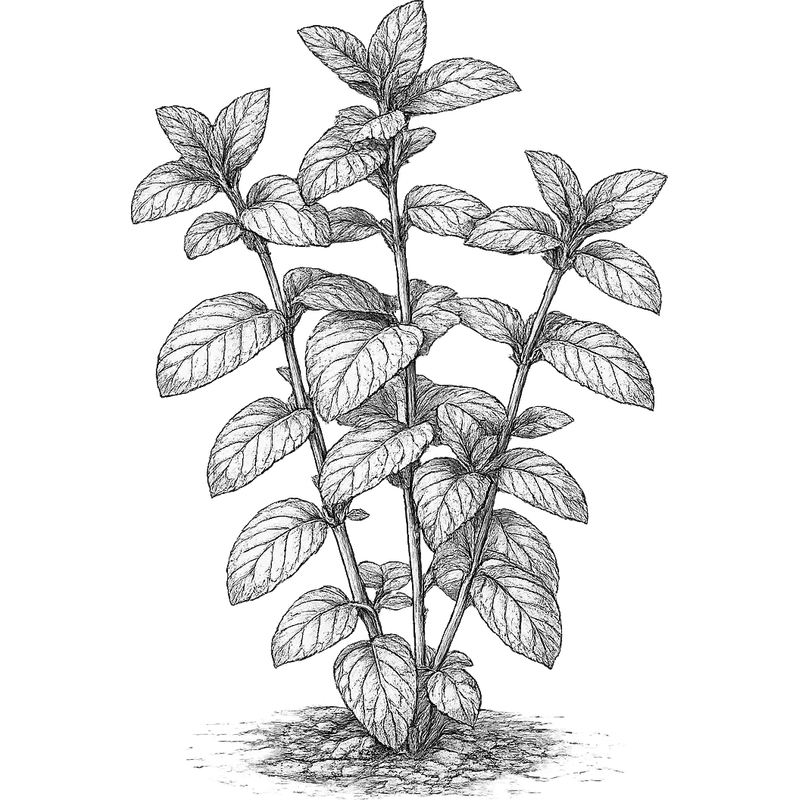
Mint splits in two. Peppermint is built on menthol and tastes cold and sharp, while spearmint is built on carvone and tastes sweet and round.[1] The cold is not a temperature but a trick. Menthol opens the same nerve channel that real cold opens, and in animal pain studies that is also how it dulls pain.[2] Peppermint's best-established use is for the gut, where it relaxes the muscle wall and eases irritable bowel syndrome.[3]
Peppermint
Mentha x piperita
- Also Known As
- Mint, Mentha Piperita
- Family
- Herbal
- Perfumery Note
- Top
- Intensity
- Strong
- Extraction
- Steam Distillation
- Plant Parts
- Flowering tops, Leaves
- Origins
- United States, India, China
- Effect
- Focus & Mental Clarity, Respiratory Support
- Aroma
- Minty, Fresh, Cool
- Applications
- Diffusing & Inhalation, Massage & Body, Cooking & Flavouring, Household & Cleaning
- Price
- $$$$Considered "premium" English peppermint; yield is standard, but the specific quality and heritage drive the price
Peppermint is the coldest of the mints, and it earns that by being over a third menthol. Menthol opens the nerve channel that reports cold, so the sensation is real even though nothing has cooled down. Its steadier reputation is for the gut, where it relaxes the muscle of the intestinal wall. In a placebo-controlled trial, 75% of people with irritable bowel syndrome halved their symptoms on peppermint capsules, against 38% on placebo.[4] Reviews also credit it with easing pain and swelling and holding back bacteria.[5]
Spearmint
Mentha spicata
- Also Known As
- Garden Mint, Common Mint
- Family
- Herbal
- Perfumery Note
- Top
- Intensity
- Medium
- Extraction
- Steam Distillation
- Plant Parts
- Flowering tops, Leaves
- Origins
- United States, China, India
- Effect
- Focus & Mental Clarity, Energy & Uplifting, Warming & Comforting
- Aroma
- Minty, Sweet, Fresh
- Applications
- Diffusing & Inhalation, Cooking & Flavouring
- Price
- $$$$Mass-produced globally for the chewing gum and toothpaste industries
Spearmint is the mint of chewing gum and lamb sauce, sweet and cool without the bite. Most of it is carvone, which lands far more gently on the tongue and nose than menthol does. That gentleness is the whole appeal for anyone who finds peppermint too fierce. Studies in people support its old use for wind, bloating and the discomfort of indigestion.[6] Reviews also credit carvone and limonene together with protecting cells and slowing an enzyme involved in Alzheimer's.[7]
Bergamot Mint
Mentha x piperita f. citrata
- Also Known As
- Eau de Cologne Mint, Lemon Mint, Orange Mint
- Family
- Herbal
- Perfumery Note
- Top
- Intensity
- Medium
- Extraction
- Steam Distillation
- Plant Parts
- Leaves
- Origins
- United States, England, France
- Effect
- Sleep & Relaxation
- Aroma
- Citrus, Mint, Floral, Fresh
- Applications
- Diffusing & Inhalation, Perfumery & Fragrance Making, Cooking & Flavouring
- Price
- $$$$A hardy perennial that spreads like a weed and yields oil easily
Bergamot mint is a mint with no mint in it. Instead of menthol it makes linalool and linalyl acetate, the soft floral compounds that carry lavender. The result smells of citrus and flowers, which is why it is also called eau de cologne mint. Its leaves are unusually loaded with flavones that damp down allergic reactions. Two of them were among the most powerful ever reported for any flavonoid, in lab tests on the cells that trigger allergy.[8]
Cornmint
Mentha arvensis
- Also Known As
- Field Mint, Wild Mint, Japanese Mint
- Family
- Herbal
- Perfumery Note
- Top
- Intensity
- Strong
- Extraction
- Steam Distillation
- Plant Parts
- Leaves, Flowering tops
- Origins
- India, China, Nepal
- Effect
- Focus & Mental Clarity, Respiratory Support
- Aroma
- Minty, Sharp, Cooling
- Applications
- Diffusing & Inhalation, Cooking & Flavouring
- Price
- $$$$Grown at enormous industrial scale across India and China primarily to supply the natural menthol crystal market, keeping the crude oil inexpensive
Cornmint is where most of the world's menthol comes from. It holds more than any other mint, up to nine tenths of the oil. Much of the crop is processed to take those menthol crystals out and sell them on their own. What is left smells sharper and more medicinal than peppermint. The oil kills the moulds that spoil stored grain,[9] and in mice it calmed the inflammation behind eczema-like skin.[10]
References
- [1]Chemical Composition and Antioxidant Properties of Essential Oils from Peppermint, Native Spearmint and Scotch Spearmint - Wu Z, Tan B, Liu Y, et al. Molecules, 2019
- [2]TRPM8 is the principal mediator of menthol-induced analgesia of acute and inflammatory pain - Liu B, Fan L, Balakrishna S, et al. Pain, 2013
- [3]Review article: the physiological effects and safety of peppermint oil and its efficacy in irritable bowel syndrome and other functional disorders - Chumpitazi BP, Kearns GL, Shulman RJ. Alimentary Pharmacology & Therapeutics, 2018
- [4]Peppermint oil (Mintoil) in the treatment of irritable bowel syndrome: a prospective double blind placebo-controlled randomized trial - Cappello G, Spezzaferro M, Grossi L, Manzoli L, Marzio L. Digestive and Liver Disease, 2007
- [5]Peppermint essential oil: its phytochemistry, biological activity, pharmacological effect and application - Zhao H, Ren S, Yang H, Tang S, Guo C, Liu M, Tao Q, Ming T, Xu H. Biomedicine & Pharmacotherapy, 2022
- [6]Mentha spicata L. essential oil, phytochemistry and its effectiveness in flatulence - Mahboubi M. Journal of Traditional and Complementary Medicine, 2021
- [7]Bioactive properties of the aromatic molecules of spearmint (Mentha spicata L.) essential oil: a review - Zhang L-L, Chen Y, Li Z-J, Li X, Fan G. Food & Function, 2022
- [8]High antiallergic activity of 5,6,4'-trihydroxy-7,8,3'-trimethoxyflavone and 5,6-dihydroxy-7,8,3',4'-tetramethoxyflavone from eau de cologne mint (Menthaxpiperita citrata) - Sato A et al. Fitoterapia, 2015
- [9]Evaluation of Mentha arvensis essential oil and its major constituents for fungitoxicity - Kaur Makkar M, Sharma S, Kaur H. Journal of Food Science and Technology, 2018
- [10]Mentha arvensis Essential Oil Exerts Anti-Inflammatory in LPS-Stimulated Inflammatory Responses via Inhibition of ERK/NF-kB Signaling Pathway and Anti-Atopic Dermatitis-like Effects in 2,4-Dinitrochlorobenzene-Induced BALB/c Mice - Kim SY et al. Antioxidants, 2021