 Essential Nose
Nutmeg
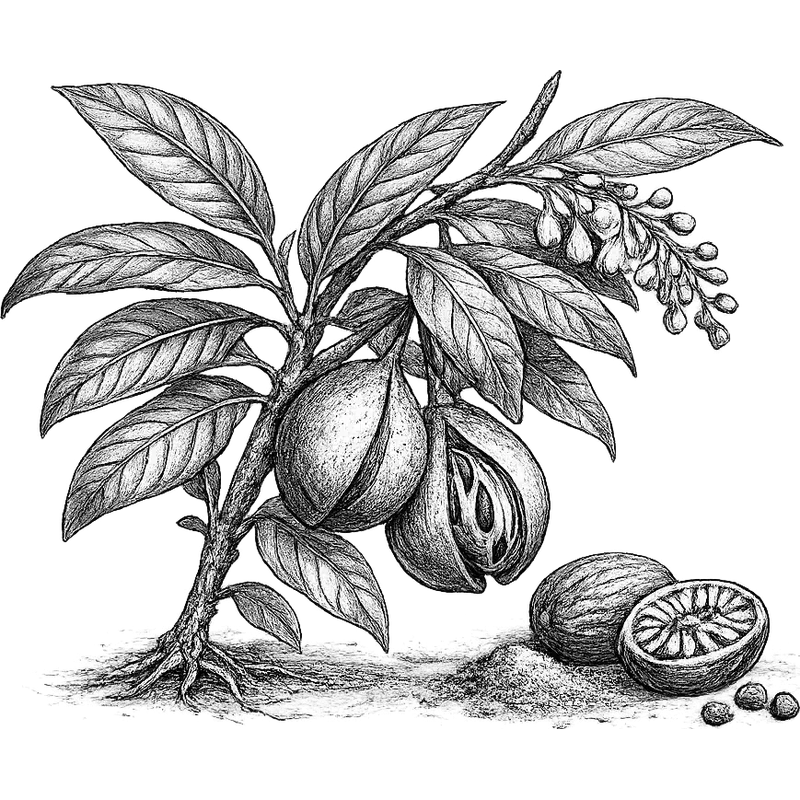
Nutmeg gives two different oils from the same fruit. The seed gives nutmeg oil, warm and sharp, while the lacy red coat around it gives mace, softer and sweeter. Both carry myristicin, which is why both need care. Myristicin is mildly psychoactive at high doses and acts as an MAO inhibitor, which matters if you take antidepressants.[1] At normal aromatic doses that is not a concern, but nutmeg is not an oil to be casual with.[1]
Nutmeg Seed
Myristica fragrans
- Also Known As
- Nutmeg, Nutmeg Tree
- Family
- Spice
- Perfumery Note
- Middle
- Intensity
- Strong
- Extraction
- Steam Distillation
- Plant Parts
- Seeds
- Origins
- Indonesia, India, Sri Lanka
- Effect
- Focus & Mental Clarity, Warming & Comforting
- Aroma
- Spicy, Warm, Sweet
- Applications
- Diffusing & Inhalation, Massage & Body, Cooking & Flavouring
- Price
- $$$$A common spice with a decent yield, but the oil is highly potent and requires precise distillation
Nutmeg oil is distilled from the seed, and about half of it is sabinene, a peppery pine-like compound. Alpha- and beta-pinene sit behind it, with eugenol adding the warm spice you expect from grated nutmeg. Myristicin is the one to watch: mildly psychoactive in quantity and an MAO inhibitor, so it interacts with some antidepressants.[1] Aromatic use at normal dilution is a long way from that, but it is worth knowing. Reviews credit the oil with holding back bacteria and protecting cells from damage.[1]
Mace
Myristica fragrans
- Also Known As
- Macis, Nutmeg Aril, Myristica Fragrans Arillus Oil
- Family
- Spice
- Perfumery Note
- Middle
- Intensity
- Medium
- Extraction
- Steam Distillation
- Plant Parts
- Aril
- Origins
- Indonesia, Grenada, Sri Lanka
- Effect
- Focus & Mental Clarity, Energy & Uplifting
- Aroma
- Sweet, Spicy, Warm, Delicate
- Applications
- Diffusing & Inhalation, Massage & Body, Perfumery & Fragrance Making, Cooking & Flavouring
- Price
- $$$$The lacy aril makes up a small fraction of each nutmeg fruit and must be hand-separated before distillation, making mace oil more labor-intensive to produce than nutmeg seed oil.
Mace is the lacy red coat that wraps the nutmeg seed, and it gives its own oil. It smells softer and sweeter than nutmeg, less pungent and more delicate, though the chemistry is close. The aril actually yields more oil than the seed does, around a tenth of its weight.[2] Isolated myristicin from mace reduced swelling in rats almost as well as indomethacin, a standard drug for swelling.[3] It shares nutmeg's myristicin, so it needs the same conservative dosing.
References
- [1]Nutmeg (Myristica fragrans Houtt.) essential oil: A review on its composition, biological, and pharmacological activities - Ashokkumar K et al. Phytotherapy Research, 2022
- [2]Does fixed oil impart more antioxidant potential to spices than essential oils? A comparative study with seed (nutmeg) and aril (mace) oil from the spice Myristica fragrans - Sheikh SA, Manasa V, Daga P. Journal of Food Science and Technology, 2025
- [3]Antiinflammatory effect of mace, aril of Myristica fragrans Houtt., and its active principles - Ozaki Y, Soedigdo S, Wattimena YR, Suganda AG. Japanese Journal of Pharmacology, 1989