 Essential Nose
Orange
Genus Citrus
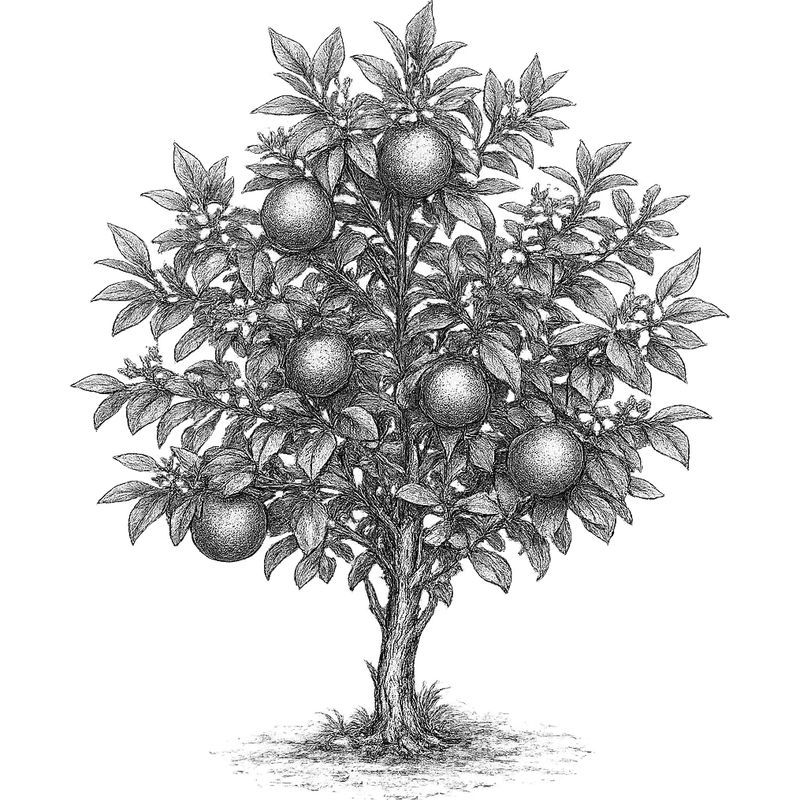
One tree gives three completely different oils, depending on which part you use. The peel, pressed cold, is almost pure limonene and smells like the fruit itself. The blossom gives neroli, delicate and deeply floral, and the leaves and twigs give petitgrain, green and woody in between. In animal studies, repeated doses of bitter orange oil eased anxious behaviour by acting on a serotonin receptor.[1] In a trial of children having dental treatment, orange oil in the air lowered both their saliva cortisol and their pulse.[2]
Sweet Orange
Citrus sinensis
- Also Known As
- Orange, Sweet Orange Peel
- Family
- Citrus
- Perfumery Note
- Top
- Intensity
- Medium
- Extraction
- Cold Pressed
- Plant Parts
- Fruit peel
- Origins
- Brazil, United States, Italy
- Effect
- Energy & Uplifting
- Aroma
- Citrus, Sweet, Fruity
- Applications
- Diffusing & Inhalation, Perfumery & Fragrance Making, Cooking & Flavouring, Household & Cleaning
- Price
- $$$$The most produced essential oil in the world; a massive byproduct of the juice industry
Sweet orange oil is squeezed from the peel, which is why it smells exactly like scratching a fresh orange. Nine tenths of it is limonene, the compound behind that bright, round sweetness. In animal studies, breathing it in reversed low-mood behaviour and calmed an overactive stress response.[3] In a controlled study in people, volunteers who smelled it before a stressful task showed no rise in anxiety, tension or heart rate.[4]
Neroli
Citrus aurantium var. amara
- Also Known As
- Orange Blossom, Bitter Orange Flower
- Family
- Floral
- Perfumery Note
- Middle
- Intensity
- Medium
- Extraction
- Steam Distillation
- Plant Parts
- Blossoms
- Origins
- Tunisia, Morocco, France
- Effect
- Sleep & Relaxation, Romance & Mood
- Aroma
- Floral, Citrus, Fresh
- Applications
- Diffusing & Inhalation, Skincare, Perfumery & Fragrance Making
- Price
- $$$$Steam-distilled from hand-picked orange blossoms; thousands of petals produce only a tiny drop of oil
Neroli is distilled from bitter orange blossom, and it takes a great many flowers to fill a small bottle. It smells green, honeyed and unmistakably floral, softened by indole, the same compound that gives jasmine its animal warmth. Few oils have better human evidence for calming nerves. In a trial of 140 heart patients, breathing it in lowered anxiety more than a dummy scent.[5] In a trial of women in labour, it lowered anxiety at every stage measured.[6]
Petitgrain
Citrus aurantium var. amara
- Also Known As
- Petitgrain Bigarade, Bitter Orange Leaf
- Family
- Citrus
- Perfumery Note
- Top
- Intensity
- Medium
- Extraction
- Steam Distillation
- Plant Parts
- Leaves, Twigs
- Origins
- Paraguay, France, Tunisia
- Effect
- Grounding & Centering, Sleep & Relaxation
- Aroma
- Citrus, Woody, Herbaceous
- Applications
- Diffusing & Inhalation, Skincare, Perfumery & Fragrance Making
- Price
- $$$$Distilled from mandarin tree leaves; distinct from the peel oil
Petitgrain comes from the leaves and twigs of the same tree that gives neroli and bitter orange. It sits between them, green and woody with the orange still recognisable underneath. Around half the oil is linalyl acetate, the compound that makes lavender smell calm rather than sharp. In a controlled study, university staff who inhaled it worked better, which the researchers put down to a steadying effect on the nervous system.[7] The leaves are richest in that compound in autumn, and the oil also protects cells from damage.[8]
Bitter Orange
Citrus aurantium var. amara
- Also Known As
- Seville Orange, Sour Orange
- Family
- Citrus
- Perfumery Note
- Top
- Intensity
- Medium
- Extraction
- Cold Pressed
- Plant Parts
- Fruit peel
- Origins
- Italy, Spain, Tunisia
- Effect
- Sleep & Relaxation, Focus & Mental Clarity, Energy & Uplifting
- Aroma
- Citrus, Bitter, Fresh
- Applications
- Diffusing & Inhalation, Perfumery & Fragrance Making, Cooking & Flavouring
- Price
- $$$$Peel is a byproduct of bitter orange processing for food and liqueur industries; lower demand compared to sweet orange keeps the price modest
Bitter orange oil is pressed from the rind of the fruit that makes marmalade. Like sweet orange it is mostly limonene, but traces of heavier compounds add a resinous, bitter edge. It is the only one of the three bitter orange oils studied for the stomach. In rats with induced ulcers, the oil healed 44% and pure limonene 56%, by growing new blood vessels and thickening the protective mucus.[9] Testing also finds it protects cells and slows enzymes tied to Alzheimer's and diabetes.[10]
Blood Orange
Citrus sinensis
- Also Known As
- Moro Orange, Tarocco Orange, Sanguinello, Pigmented Orange
- Family
- Citrus
- Perfumery Note
- Top
- Intensity
- Medium
- Extraction
- Cold Pressed
- Plant Parts
- Fruit peel
- Origins
- Italy, Spain, United States
- Effect
- Energy & Uplifting, Sleep & Relaxation
- Aroma
- Citrus, Sweet, Berry-like
- Applications
- Diffusing & Inhalation, Perfumery & Fragrance Making, Cooking & Flavouring
- Price
- $$$$A cold-pressed byproduct of the pigmented orange juice industry, similar in cost structure to sweet orange but produced in smaller regional volumes
Blood orange oil is pressed from red-fleshed varieties like Moro and Tarocco. It is mostly limonene, like ordinary sweet orange, but a trace of beta-damascenone adds the faint berry edge. The red does not come through: the pigments that colour the flesh dissolve in water, not oil, so the oil is the usual orange gold. In lab tests the oil and limonene calmed inflammation, protected cells from damage and slowed enzymes that act on skin.[11]
References
- [1]Citrus aurantium L. essential oil exhibits anxiolytic-like activity mediated by 5-HT(1A)-receptors and reduces cholesterol after repeated oral treatment - Costa CAR, Cury TC, Cassettari BO, et al. BMC Complementary and Alternative Medicine, 2013
- [2]Effect of aromatherapy with orange essential oil on salivary cortisol and pulse rate in children during dental treatment: A randomized controlled clinical trial - Jafarzadeh M, Arman S, Pour FF. Advances in Biomedical Research, 2013
- [3]Antidepressant-like Effect of Citrus sinensis (L.) Osbeck Essential Oil and Its Main Component Limonene on Mice - Zhang L-L, Yang Z-Y, Fan G, Ren J-N, Yin K-J, Pan S-Y. Journal of Agricultural and Food Chemistry, 2019
- [4]Effect of sweet orange aroma on experimental anxiety in humans - Goes TC, Antunes FD, Alves PB, Teixeira-Silva F. Journal of Alternative and Complementary Medicine, 2012
- [5]Citrus aurantium Aroma for Anxiety in Patients with Acute Coronary Syndrome: A Double-Blind Placebo-Controlled Trial - Moslemi F, Alijaniha F, Naseri M, Kazemnejad A, Charkhkar M, Heidari MR. Journal of Alternative and Complementary Medicine, 2019
- [6]The Effectiveness of Neroli Essential Oil in Relieving Anxiety and Perceived Pain in Women during Labor: A Randomized Controlled Trial - Scandurra C, Mezzalira S, Cutillo S, Zapparella R, Statti G, Maldonato NM, Locci M, Bochicchio V. Healthcare (Basel), 2022
- [7]Aromatherapy Improves Work Performance Through Balancing the Autonomic Nervous System - Huang L, Capdevila L. Journal of Alternative and Complementary Medicine, 2017
- [8]Season's variation impact on Citrus aurantium leaves essential oil: chemical composition and biological activities - Ellouze I, Abderrabba M, Sabaou N, Mathieu F, Lebrihi A, Bouajila J. Journal of Food Science, 2012
- [9]Healing actions of essential oils from Citrus aurantium and d-limonene in the gastric mucosa: the roles of VEGF, PCNA, and COX-2 in cell proliferation - Moraes TM, Rozza AL, Kushima H, Pellizzon CH, Rocha LRM, Hiruma-Lima CA. Journal of Medicinal Food, 2013
- [10]Metabolic profiling and enzyme inhibitory activity of the essential oil of Citrus aurantium fruit peel - Ashmawy NS, Nilofar N, Zengin G, Eldahshan OA. BMC Complementary Medicine and Therapies, 2024
- [11]Chemical Composition and Assessment of the Anti-Inflammatory, Antioxidant, Cytotoxic and Skin Enzyme Inhibitory Activities of Citrus sinensis (L.) Osbeck Essential Oil and Its Major Compound Limonene - El Hachlafi N et al. Pharmaceuticals, 2024