 Essential Nose
Patchouli
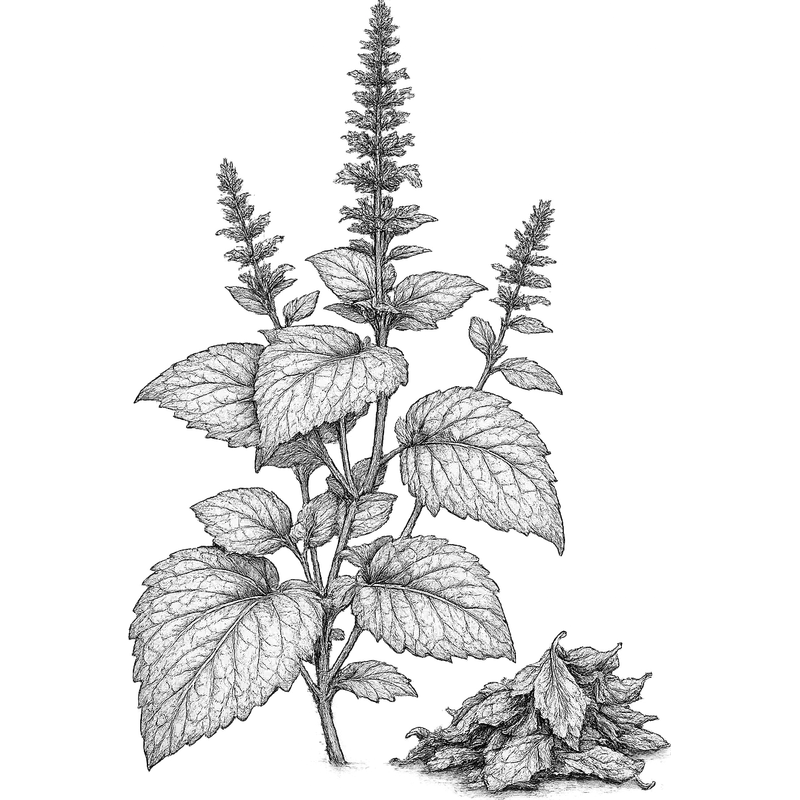
Patchouli is made from leaves that are dried and left to ferment before distilling, which is unusual. A third of the oil is patchouli alcohol, which gives the dense, earthy smell. It is also one of perfumery's best fixatives, holding lighter scents in place for longer. Almost alone among essential oils, it improves with age, growing smoother and rounder as it slowly oxidises. In a rat model of depression, the oil raised dopamine and worked about as well as fluoxetine.[2]
Patchouli
Pogostemon cablin
- Also Known As
- Patchouly
- Family
- Woody
- Perfumery Note
- Base
- Intensity
- Strong
- Extraction
- Steam Distillation
- Plant Parts
- Leaves
- Origins
- Indonesia, India, China
- Effect
- Grounding & Centering, Romance & Mood
- Aroma
- Earthy, Woody, Musky
- Applications
- Diffusing & Inhalation, Skincare, Massage & Body, Perfumery & Fragrance Making
- Price
- $$$$Pogostemon cablin is grown at large industrial scale in Indonesia and India; high leaf yield per hectare and straightforward steam distillation keep costs low
This is standard dark patchouli, thick, brown and unmistakably earthy. Between a third and two fifths of it is patchouli alcohol, which carries almost the whole smell. In animal studies that compound calmed inflammation by shutting down two of the routes the body uses to produce it.[2] It also works against a broad range of bacteria, including MRSA, which resists common antibiotics.[3] Few base notes in perfumery have been studied this closely.
Light Patchouli
Pogostemon cablin
- Also Known As
- White Patchouli, Refined Patchouli, Redistilled Patchouli
- Family
- Woody
- Perfumery Note
- Base
- Intensity
- Strong
- Extraction
- Steam Distillation
- Plant Parts
- Leaves
- Origins
- Indonesia, India
- Effect
- Sleep & Relaxation, Grounding & Centering
- Aroma
- Woody, Clean, Earthy, Soft, Musky
- Applications
- Diffusing & Inhalation, Skincare, Perfumery & Fragrance Making
- Price
- $$$$Redistillation adds processing cost and yield loss on top of already-expensive standard patchouli; commands a notable premium over dark patchouli
Light patchouli is dark patchouli run through the still a second time. The second pass strips out the heavy coloured compounds and the damp, raw-earth note, leaving something paler and cleaner.[4] The patchouli alcohol survives it, still around a third to two fifths of the oil, so the character and the effects carry over.[4] Reviews credit that compound with calming inflammation, fighting fungi and flu, and protecting nerve cells.[5] It is the version to choose if you want patchouli without the compost heap.
References
- [1]Antidepressant-like Activity of Patchouli Oil var. Tapak Tuan (Pogostemon cablin Benth) via Elevated Dopamine Level: A Study Using Rat Model - Astuti P et al. Pharmaceuticals (Basel), 2022
- [2]Anti-inflammatory activity of patchouli alcohol isolated from Pogostemonis Herba in animal models - Liao H et al. Journal of Ethnopharmacology, 2011
- [3]In Vitro and In Vivo Antibacterial Activity of Patchouli Alcohol from Pogostemon cablin - Li YC et al. Molecules, 2016
- [4]Quantitative and physical evaluation of patchouli essential oils obtained from different sources of Pogostemon cablin - Swamy MK, Sinniah UR. Evidence-Based Complementary and Alternative Medicine, 2012
- [5]Potential benefits of patchouli alcohol in prevention of human diseases: A mechanistic review - Yang X, Zhang Y, Yang Y, Lim S, Cao Z, Ong J, Wang JW. Biomedicine & Pharmacotherapy, 2021