 Essential Nose
Sandalwood
Genus Santalum
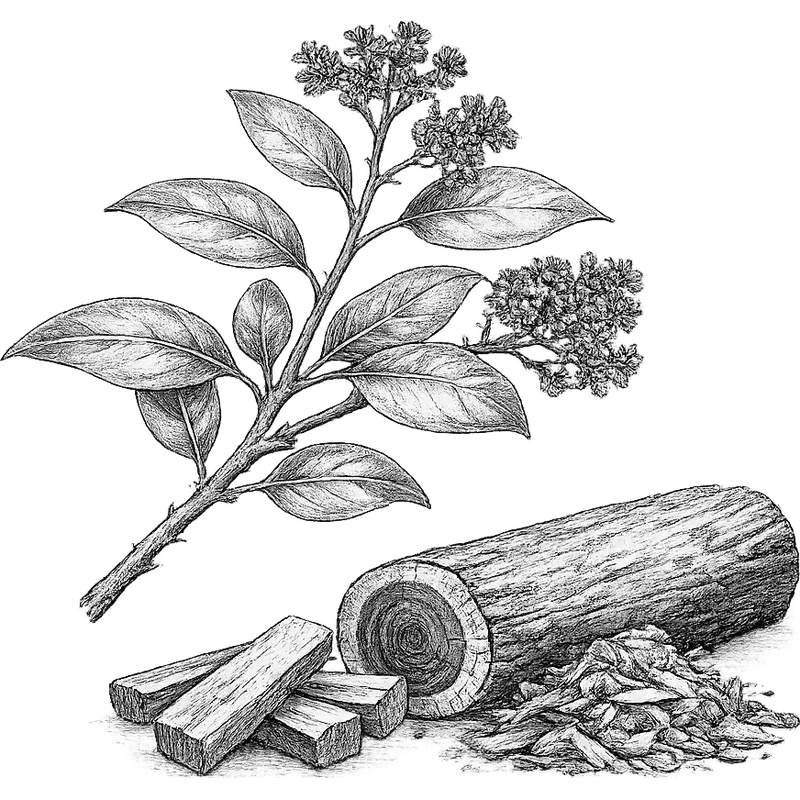
Sandalwood's creamy warmth comes down to two compounds, alpha- and beta-santalol, and how much of them a tree has made. Indian sandalwood has the most and is the benchmark, but the species is endangered, so Australian and Hawaiian trees now supply much of the market. Those are drier and less sweet, not worse. In a study of people absorbing it through the skin, santalol alone was calming while the whole oil made them more alert as well.[1] Brain recordings during inhalation show it engages the front of the brain rather than simply sedating.[2]
East Indian Sandalwood
Santalum album
- Also Known As
- Sandalwood, White Sandalwood, Mysore Sandalwood
- Family
- Woody
- Perfumery Note
- Base
- Intensity
- Medium
- Extraction
- Steam Distillation
- Plant Parts
- Wood
- Origins
- India, Australia, Hawaii
- Effect
- Sleep & Relaxation, Grounding & Centering
- Aroma
- Woody, Creamy, Light
- Applications
- Diffusing & Inhalation, Skincare, Massage & Body, Perfumery & Fragrance Making
- Price
- $$$$Santalum album trees take 30-60 years to mature and are CITES-listed; tightly controlled Indian government exports and exceptionally high global demand from perfumery and ritual use make it the most expensive sandalwood
This is the benchmark sandalwood, and about three quarters of the oil is santalol.[3] Nothing else in the genus gets close, which is why the species has been cut nearly to extinction. Absorbed through the skin, santalol alone calmed people while the whole oil also made them more alert.[1] Clinical trials on skin found it safe and well tolerated for acne, eczema and psoriasis.[4] It calms inflammation by blocking the same enzyme routes that ibuprofen and aspirin act on.[4]
Australian Sandalwood
Santalum spicatum
- Also Known As
- Western Australian Sandalwood
- Family
- Woody
- Perfumery Note
- Base
- Intensity
- Medium
- Extraction
- Steam Distillation
- Plant Parts
- Wood
- Origins
- Australia
- Effect
- Sleep & Relaxation, Grounding & Centering
- Aroma
- Woody, Dry, Earthy
- Applications
- Diffusing & Inhalation, Skincare, Massage & Body, Perfumery & Fragrance Making
- Price
- $$$$Santalum spicatum from Western Australia is grown on certified sustainable plantations with a faster rotation than S. album; greater supply and lower regulatory burden place it well below East Indian sandalwood in price
Australian sandalwood is the dry one, less creamy and more green than Indian. It holds only about a fifth santalol, with farnesol filling the gap and giving that diffuse, open woodiness.[3] Trees in the north and southwest of Western Australia make the most santalol.[5] In a controlled study, people who inhaled it had lower cortisol in their saliva while recovering from a stressor.[6] It is the sustainable choice, since the Indian species is endangered.
Hawaiian Sandalwood
Santalum paniculatum
- Also Known As
- Iliahi, Royal Hawaiian Sandalwood
- Family
- Woody
- Perfumery Note
- Base
- Intensity
- Medium
- Extraction
- Steam Distillation
- Plant Parts
- Wood
- Origins
- Hawaii
- Effect
- Romance & Mood, Grounding & Centering
- Aroma
- Woody, Sweet, Rich
- Applications
- Diffusing & Inhalation, Skincare, Massage & Body, Perfumery & Fragrance Making
- Price
- $$$$Santalum paniculatum is harvested in very limited quantities from Hawaiian forests under strict conservation rules; the tiny production volume and strong provenance premium make it one of the most expensive sandalwood variants
Hawaiian sandalwood sits between the Indian and Australian trees on every measure. Around a third of the oil is alpha-santalol, more than Australian and less than Indian.[7] Less beta-santalol and more spirosantalol make it lighter and slightly floral where Indian is dense and creamy.[7] Reviews of alpha-santalol itself credit it with calming inflammation, protecting cells and acting against viruses.[8] That is about the compound rather than trials of this particular oil.
African Sandalwood
Osyris lanceolata
- Also Known As
- East African Sandalwood, Kenyan Sandalwood, African Sandalwood
- Family
- Woody
- Perfumery Note
- Base
- Intensity
- Medium
- Extraction
- Steam Distillation
- Plant Parts
- Wood
- Origins
- Kenya, Tanzania, Ethiopia
- Effect
- Grounding & Centering, Sleep & Relaxation
- Aroma
- Woody, Creamy, Mild, Earthy
- Applications
- Diffusing & Inhalation, Skincare, Massage & Body, Perfumery & Fragrance Making
- Price
- $$$$Osyris tenuifolia from East Africa is a different genus to true sandalwood; it is harvested opportunistically at small scale, keeping supply low and prices moderate without the luxury premium of Santalum species
African sandalwood is not sandalwood, but a different tree used as a stand-in. Like real sandalwood it feeds partly off the roots of neighbouring plants, and like real sandalwood it has been cut too hard. It is now listed as endangered.[9] Work on a close relative found compounds that true sandalwood does not make at all, so the smell is milder and earthier rather than creamy.[10] There is no research on what this oil does, only on what is in it.
New Caledonian Sandalwood
Santalum austrocaledonicum
- Also Known As
- Pacific Sandalwood, Vanuatu Sandalwood
- Family
- Woody
- Perfumery Note
- Base
- Intensity
- Medium
- Extraction
- Steam Distillation
- Plant Parts
- Wood
- Origins
- New Caledonia, Vanuatu
- Effect
- Grounding & Centering, Sleep & Relaxation
- Aroma
- Woody, Creamy, Sweet, Soft
- Applications
- Diffusing & Inhalation, Skincare, Massage & Body, Perfumery & Fragrance Making
- Price
- $$$$Santalum austrocaledonicum is grown on certified Pacific island plantations with improving yields; more accessible than East Indian but still a premium oil due to its authentic Santalum genus and island logistics costs
This sandalwood grows in New Caledonia and Vanuatu, and smells softer and sweeter than the Indian benchmark. It runs on the same two santalols, with extra lanceol giving it its own signature.[11] Quality varies enormously from tree to tree. In a survey of wild Vanuatu trees, only about one in five met the international standard for santalol content.[11] That is why where the wood came from matters more here than with most oils.
References
- [1]Evaluation of the effects of East Indian sandalwood oil and alpha-santalol on humans after transdermal absorption - Hongratanaworakit T, Heuberger E, Buchbauer G. Planta Med, 2004
- [2]Effects of inhaling essential oils of Citrus limonum L., Santalum album, and Cinnamomum camphora on human brain activity - Ueda K, Horita T, Suzuki T. Brain and Behavior, 2023
- [3]A Comparison of the Composition of Selected Commercial Sandalwood Oils with the International Standard - Kucharska M, Frydrych B, Wesolowski W, Szymanska JA, Kilanowicz A. Molecules, 2021
- [4]Sandalwood Album Oil as a Botanical Therapeutic in Dermatology - Moy RL, Levenson C. Journal of Clinical and Aesthetic Dermatology, 2017
- [5]Sesquiterpene Variation in West Australian Sandalwood (Santalum spicatum) - Moniodis J et al. Molecules, 2017
- [6]A Pilot Study on the Physiological Effects of Three Essential Oils in Humans - Hoferl M, Hutter C, Buchbauer G. Natural Products Communications, 2016
- [7]Hawaiian sandalwood: oil composition of Santalum paniculatum and comparison with other sandal species - Braun NA, Sim S, Kohlenberg B, Lawrence BM. Natural Products Communications, 2014
- [8]Medicinal properties of alpha-santalol, a naturally occurring constituent of sandalwood oil: review - Bommareddy A et al. Natural Products Research, 2019
- [9]Knowledge Gaps in Taxonomy, Ecology, Population Distribution Drivers and Genetic Diversity of African Sandalwood (Osyris lanceolata Hochst. & Steud.): A Scoping Review for Conservation - Mugula BB et al. Plants (Basel), 2021
- [10]Sesquiterpenes from the east African sandalwood Osyris tenuifolia - Kreipl AT et al. Phytochemistry, 2004
- [11]Geographic and phenotypic variation in heartwood and essential-oil characters in natural populations of Santalum austrocaledonicum in Vanuatu - Page T et al. Chemistry & Biodiversity, 2010