 Essential Nose
Spruce
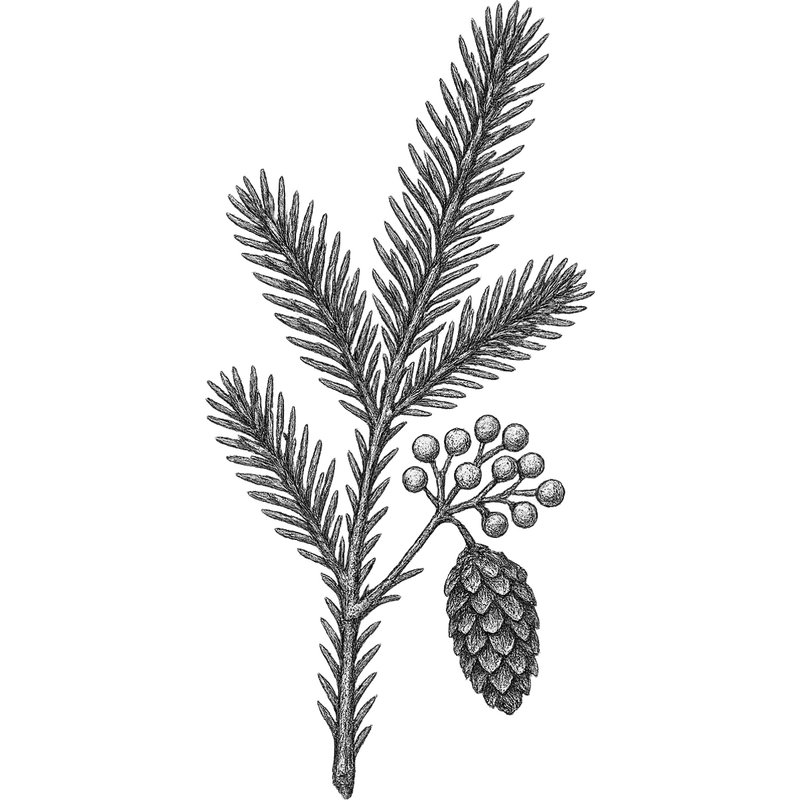
Spruce oils come from needles and smell like a forest floor rather than a Christmas tree shop. Black spruce is the standard, built on bornyl acetate, which gives a soft, damp, resinous depth. White spruce carries camphor as well and is sharper. Hemlock is not a spruce at all but a different conifer, softer again. A survey of seven boreal forest oils found all of them active against bacteria and fungi, at low concentrations.[1]
Black Spruce
Picea mariana
- Also Known As
- Spruce, Bog Spruce, Spruce Needle
- Family
- Woody
- Perfumery Note
- Middle
- Intensity
- Medium
- Extraction
- Steam Distillation
- Plant Parts
- Needles, Twigs
- Origins
- Canada, United States, Russia
- Effect
- Grounding & Centering, Respiratory Support
- Aroma
- Fresh, Coniferous, Earthy
- Applications
- Diffusing & Inhalation, Massage & Body
- Price
- $$$$Abundant in the Canadian wilderness; high oil content in the needles
Black spruce is the boreal conifer of eastern Canada, and the oil is distilled from its needles. Bornyl acetate leads, which is what gives it that damp, resinous, forest-floor smell rather than a sharp pine snap. Alpha- and beta-pinene sit behind it with limonene lifting the top. It is the spruce most used in aromatherapy, usually for grounding and for chesty breathing. A survey of seven boreal oils confirmed it holds back bacteria and fungi at low concentrations.[1]
Spruce White
Picea glauca
- Also Known As
- White Spruce
- Family
- Woody
- Perfumery Note
- Middle
- Intensity
- Medium
- Extraction
- Steam Distillation
- Plant Parts
- Needles, Twigs
- Origins
- Canada, United States
- Effect
- Grounding & Centering, Respiratory Support
- Aroma
- Fresh, Coniferous, Camphoraceous
- Applications
- Diffusing & Inhalation, Massage & Body
- Price
- $$$$Abundant boreal species with an established Canadian steam-distillation industry keeps pricing accessible
White spruce is the other great conifer of the Canadian boreal forest. Its oil carries about a fifth camphor, which black spruce does not, so it smells sharper and more medicinal. Beta-pinene matches the camphor in quantity, with bornyl acetate adding some of black spruce's softness. First Nations used it for chest complaints and on skin. In the boreal oil survey it held back bacteria and protected cells about as well as imported oils.[1]
Spruce Hemlock
Tsuga canadensis
- Also Known As
- Hemlock Spruce, Eastern Hemlock
- Family
- Woody
- Perfumery Note
- Middle
- Intensity
- Medium
- Extraction
- Steam Distillation
- Plant Parts
- Needles
- Origins
- Canada, United States
- Effect
- Grounding & Centering, Sleep & Relaxation, Respiratory Support
- Aroma
- Fresh, Coniferous, Woody
- Applications
- Diffusing & Inhalation, Massage & Body
- Price
- $$$$Limited commercial distillation and hemlock woolly adelgid pressure on wild stands keep supply small and prices elevated
Hemlock spruce is neither a hemlock nor a spruce, but an eastern North American conifer of its own. The name has nothing to do with the poison, which comes from an unrelated plant entirely. Its needle oil is more than three quarters alpha-pinene, camphene and myrcene, giving a soft, woody resin smell. A survey of thirteen hemlock varieties found the make-up varies a lot from tree to tree.[2] Some of those differences track natural resistance to the insect that has been killing the species.[2]
References
- [1]Composition, antimicrobial and antioxidant activities of seven essential oils from the North American boreal forest - Pichette A et al. Nat Prod Commun, 2015
- [2]Characterization of terpenoid volatiles from cultivars of eastern hemlock (Tsuga canadensis) - Lagalante AF, Montgomery ME, Calvosa FC, Mirzabeigi MN. Journal of Agricultural and Food Chemistry, 2007