 Essential Nose
Vetiver
Genus Chrysopogon
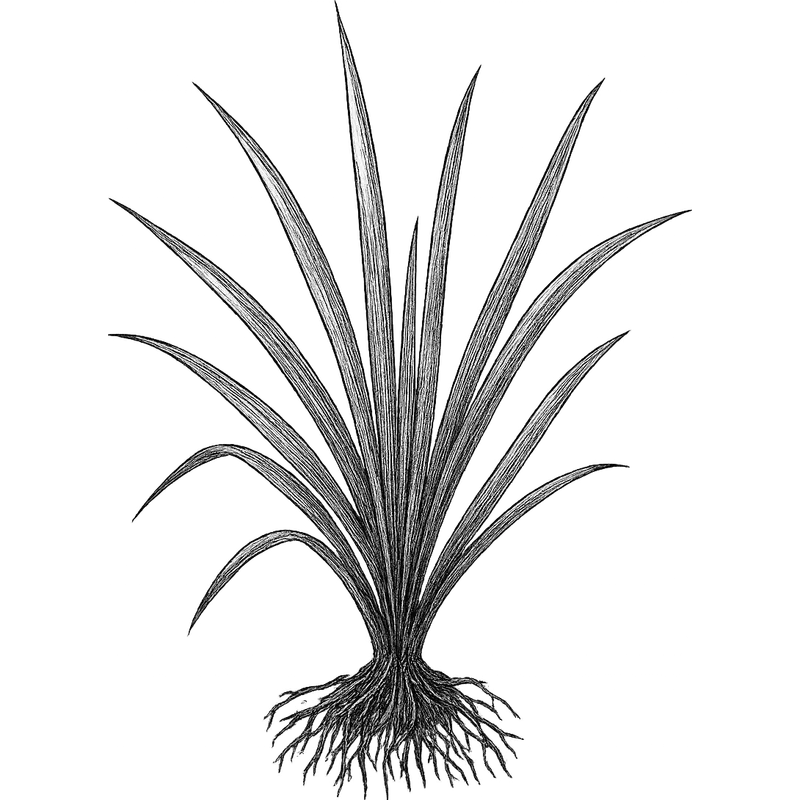
Vetiver comes from the roots of a tropical grass, which has to grow two years before they are worth digging up. The oil holds hundreds of separate compounds, which is why it smells so complex and why no two origins match. Haiti grows the most, and its oil is smoky and raw. Reunion Island gives the finer, sweeter version that haute perfumery pays for. In lab tests the oil held back Gram-positive bacteria such as Staphylococcus aureus and mopped up the unstable molecules that damage cells.[1][2]
Vetiver Bourbon
Vetiveria zizanioides
- Also Known As
- Bourbon Vetiver, Reunion Vetiver
- Family
- Woody
- Perfumery Note
- Base
- Intensity
- Strong
- Extraction
- Steam Distillation
- Plant Parts
- Roots
- Origins
- Reunion Island, Haiti, Madagascar
- Effect
- Sleep & Relaxation, Grounding & Centering
- Aroma
- Earthy, Woody, Rich
- Applications
- Diffusing & Inhalation, Skincare, Massage & Body, Perfumery & Fragrance Making
- Price
- $$$$The roots grow deep and must be dug up by hand; distillation takes over 24 hours to extract the heavy molecules
Bourbon vetiver comes from Reunion Island and is the grade haute perfumery reaches for. It is rounder and sweeter than Haitian, with less of the ashy smoke and more of the clean root. Khusimol marks it as vetiver, while the heavier compounds behind it shift with where the grass grew. Reviews of vetiver oil in cosmetics record the same antibacterial activity across origins.[3] Nothing is documented for Bourbon specifically beyond its composition and its reputation.
Haitian Vetiver
Vetiveria zizanioides
- Also Known As
- Khus, Vetivert
- Family
- Woody
- Perfumery Note
- Base
- Intensity
- Strong
- Extraction
- Steam Distillation
- Plant Parts
- Roots
- Origins
- Haiti
- Effect
- Sleep & Relaxation, Grounding & Centering
- Aroma
- Earthy, Woody, Smoky
- Applications
- Diffusing & Inhalation, Skincare, Massage & Body, Perfumery & Fragrance Making
- Price
- $$$$Haiti is the world's largest producer of vetiver oil; large-scale steam distillation of Chrysopogon zizanioides roots makes Haitian vetiver the most widely traded and affordable vetiver variant
Haitian vetiver is grown in the Artibonite Valley and is the country's biggest agricultural export. It is the smoky one, drier and more ashy than the Reunion oil, with more khusimol behind that character. Perfumers use it as an anchor, because it holds a fragrance down for hours after lighter notes have gone. In lab tests it held back Gram-positive bacteria including Staphylococcus aureus.[1] It also mops up the unstable molecules that damage cells.[2]
References
- [1]Chemical Composition, Antioxidant, and Antimicrobial Activities of Vetiveria zizanioides Essential Oil Extracted by Carbon Dioxide Expanded Ethanol - David A et al. Molecules, 2019
- [2]Seasonal phytochemical study and antimicrobial potential of Vetiveria zizanioides roots - Dos Santos DS et al. Acta Pharmaceutica, 2014
- [3]Vetiver Essential Oil in Cosmetics: What Is New? - Burger P et al. Medicines (Basel), 2017